4x2 and 6x4 foam fire trucks differ significantly in chassis structure, load bearing capacity, driving performance, mobility, and applicable scenarios. 4x2 trucks are generally more flexible and economical, suitable for urban areas and small to medium sized industrial sites; 6x4 trucks offer stronger driving capabilities and greater load capacity, making them more suitable for large industrial parks, petrochemical plants, oil depots, and other locations with high firefighting requirements.
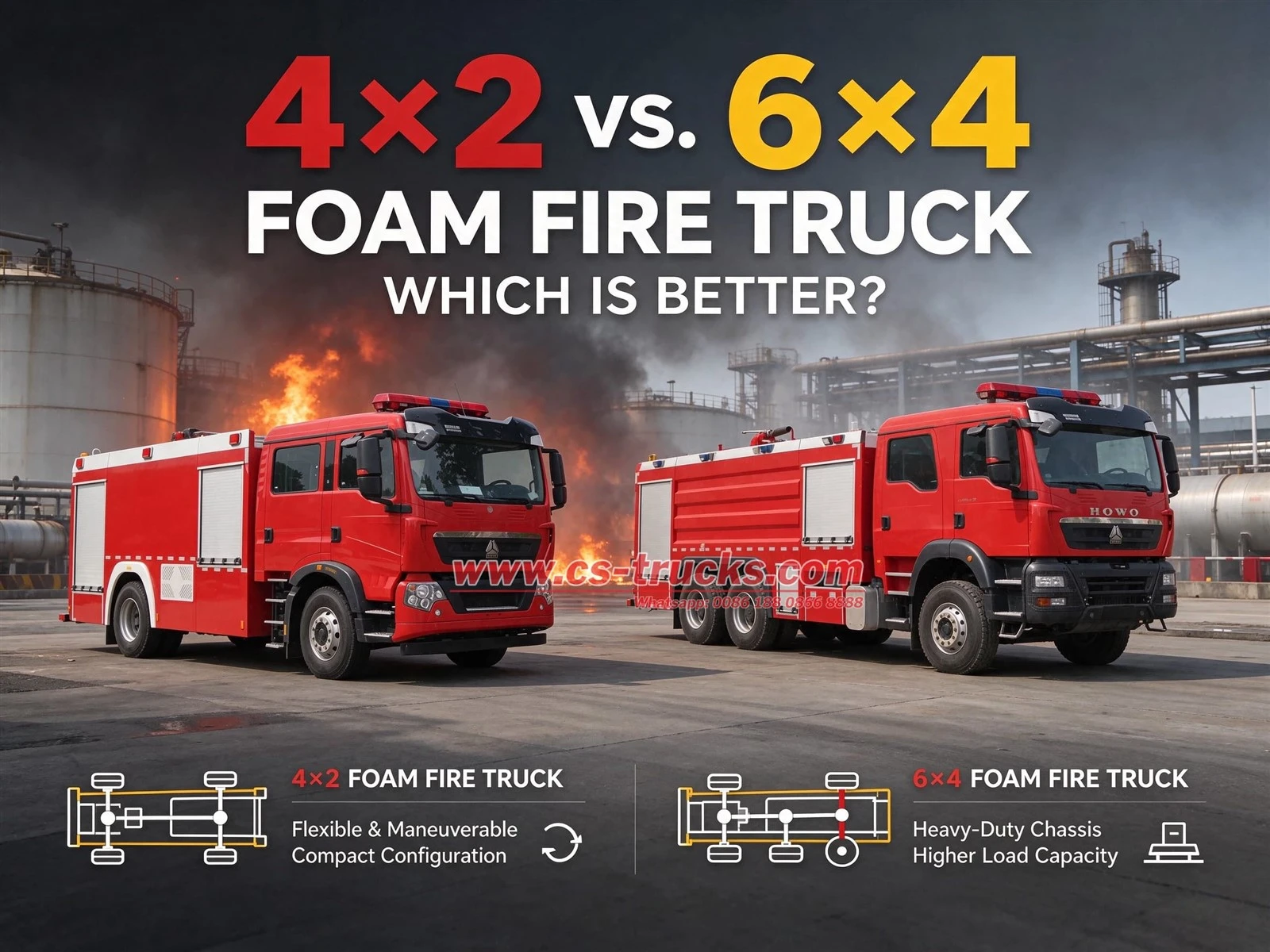
So, when purchasing foam fire trucks, should you choose a 4x2 or a 6x4? This article will compare them from multiple perspectives to help you choose the appropriate model.
What Are 4×2 and 6×4 Foam Fire Trucks?
1. 4×2 Foam Fire Trucks
The 4x2 foam fire truck uses a two axles chassis, with four wheel positions, one of which is driven by a single axle, typically the rear axle.
Key Features:
- Two axles chassis structure.
- Single axle drive.
- Relatively simple overall vehicle structure.
- Typically lighter vehicle.
- Greater maneuverability in urban areas and confined spaces.
- Suitable for small to medium sized firefighting missions.
Advantages: Simple structure, high mobility, relatively low procurement and maintenance costs.
2. 6×4 Foam Fire Trucks
The 6×4 foam fire truck uses a three axles chassis, with six wheel positions, two of which are driven by the rear axles.
Key Features:
- Three axles chassis structure.
- Dual rear axle drive.
- Greater load bearing capacity configuration potential.
- Improved traction on soft, slippery surfaces.
- Accommodates larger capacity water tanks and foam liquid tanks.
- Suitable for largescale industrial firefighting operations.
Advantages: Strong driving capability, large load configuration potential, suitable for large scale firefighting tasks.
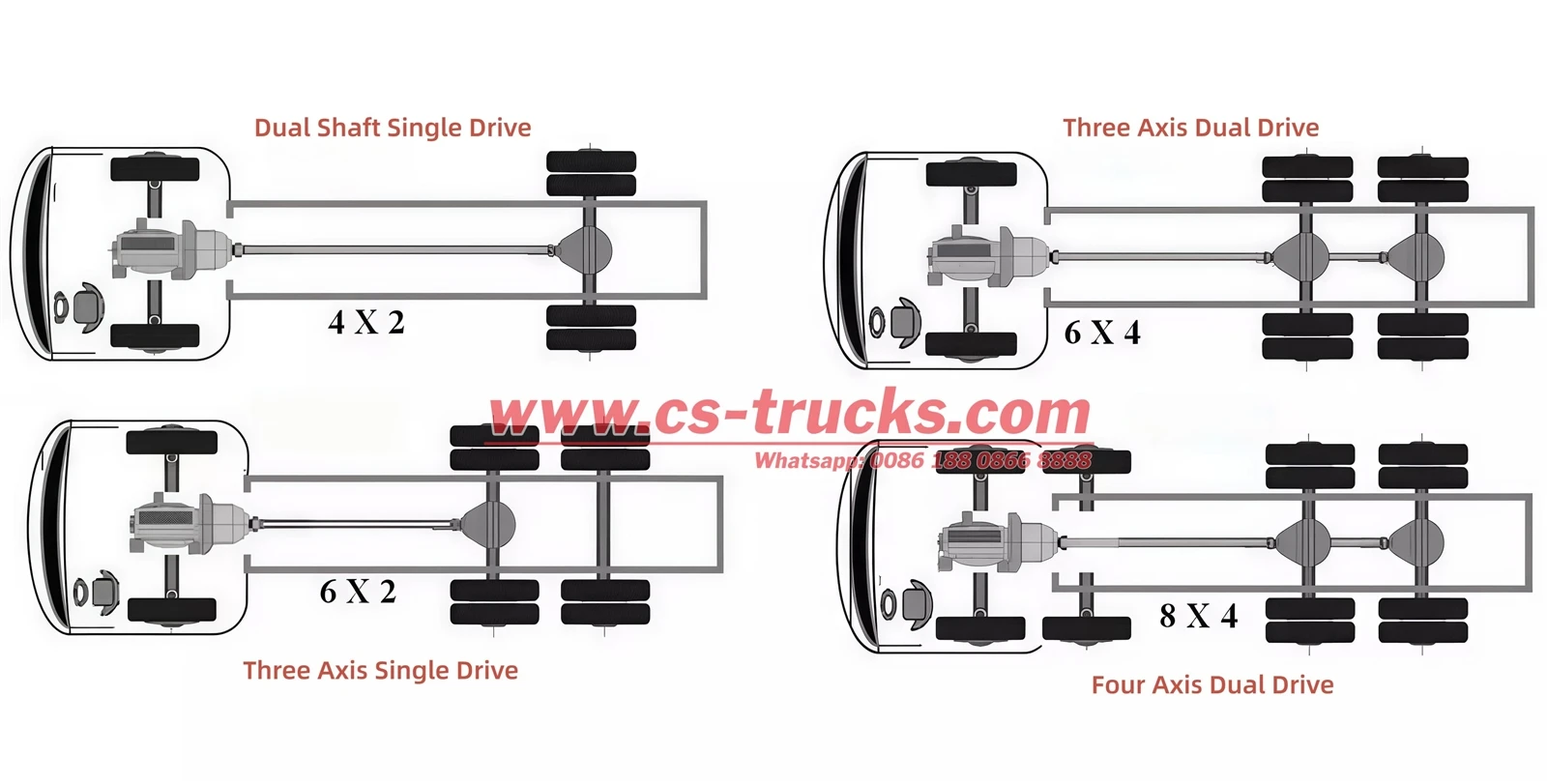
📌Attention: 4×2 and 6×4 represent the axle type and drive configuration, not the actual load capacity of the vehicle. The specific load capacity needs to be determined by considering the chassis's rated gross weight, axle load, and superstructure configuration.
4×2 vs. 6×4 Foam Fire Truck: Key Differences
The main differences between the two models are as follows:
| Comparison Projects | 4×2 Foam Fire Trucks | 6×4 Foam Fire Trucks |
| Axles | 2 | 3 |
| Wheel Positions | 4 | 6 |
| Drive Axles | 1 | 2 |
| Chassis Structure | Relatively simple | Relatively complex |
| Veight Weight | Usually lighter | Usually heavier |
| Load Capacity | Depends on chassis parameters | Usually has greater potential |
| Traction | Suitable for paved roads | Stronger traction |
| Maneuverability | Generally more flexible | The need for turning space may be greater |
| Tank Capacity | Suitable for small to medium capacity configuration | Suitable for larger capacity configurations |
| Purchase Cost | Typically lower | Usually higher |
| Maintenance | Relatively low | There are relatively more maintenance parts |
📌Note: The above are general configuration features. Actual performance will also be affected by factors such as engine power, wheelbase, tires, chassis model, and superstructure configuration.
Advantages of 4×2 Foam Fire Trucks
1) Improved Maneuverability
4×2 foam fire trucks typically employ a more compact chassis structure, making turning and U-turns easier.
In space constrained locations such as urban roads, industrial parks, warehouses, and factory premises, the 4×2 foam fire truck offers certain advantages.
2) Lower Procurement and Maintenance Costs
Compared to 6x4 models in the same class, the 4x2 chassis structure is relatively simple, with fewer mechanical parts.
Therefore, while meeting fire safety requirements, it can typically reduce vehicle procurement costs, daily maintenance costs, and some operating costs.
3) Meets Routine Firefighting Needs
For firefighting missions where the capacity requirements for water tanks and foam liquid tanks are not high, 4×2 foam fire trucks can usually provide sufficient firefighting capabilities.
4) More Flexible in Urban Areas
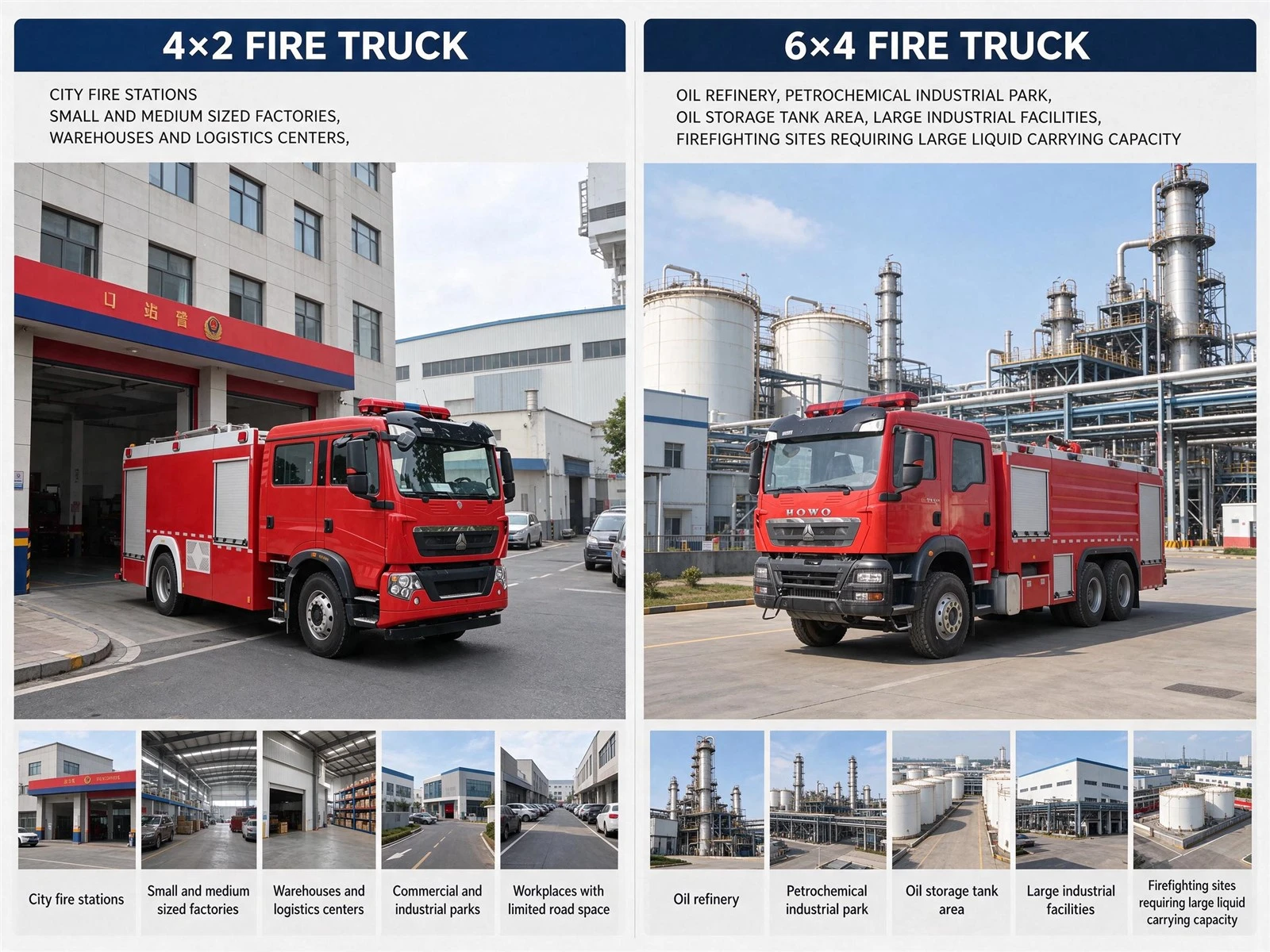
4x2 foam fire trucks are suitable for:
- City fire stations
- Small and medium sized factories
- Warehouses and logistics centers
- Commercial complexes
- General industrial parks.
Advantages of 6×4 Foam Fire Trucks
1) Stronger Load Bearing Capacity
The 6x4 foam fire truck uses a three axles chassis with two drive rear axles, providing greater load configuration potential.
For vehicles requiring the installation of large capacity water tanks, foam liquid tanks, and large firefighting equipment, the 6x4 chassis typically offers greater configuration space.
2) Better Driving Performance
The 6x4 model uses dual rear axle drive, which generally provides better traction on slippery roads, gravel roads, and soft surfaces compared to the single axle drive of the 4x2 trucks.
However, it's important to note that 6x4 is not the same as 6x6; its off road capability is still limited by the drive system and chassis structure.
3) Suitable for Large Scale Firefighting
Petrochemical plants, oil tank farms, and large industrial parks typically have high fire protection requirements. These locations may require larger foam concentrate reserves, higher fire pump flow rates, and stronger sustained fire suppression capabilities.
A 6x4 foam fire truck provides a suitable chassis platform for these large fire protection configurations.
4) Better for Heavy Equipment Configurations
When vehicles need to be equipped with high flow fire pumps, large foam cannons, large capacity tanks, and other firefighting equipment, a well designed 6×4 chassis usually offers greater configuration flexibility.
Which Applications Are Suitable for Each Configuration?
Different firefighting scenarios have different requirements for vehicle chassis, liquid capacity, and fire extinguishing capabilities.
4×2 Foam Fire Truck Applicable Scenarios:
- City fire stations
- Small and medium sized factories
- Warehouses and logistics centers
- Commercial and industrial parks
- Workplaces with limited road space
6×4 Foam Fire Truck Applicable Scenarios:
- Oil refinery
- Petrochemical industrial park
- Oil storage tank area
- Large industrial facilities
- Firefighting sites requiring large liquid carrying capacity
How To Choose The Right Foam Fire Truck?
When purchasing foam fire trucks, one should not only consider the chassis drive type, but also take into account the following five factors.
| Selection Factors | Key Considerations |
| Fire protection Requirements | Fire risk, fire extinguishing flow rate and duration of fire extinguishing |
| Tank Capacity | Required capacity of water tanks and foam liquid tanks |
| Road Conditions | Urban roads, industrial roads, gravel roads and complex road conditions |
| Vehicle Size | Road width, turning radius and parking space |
| Procurement Budget | Vehicle procurement, fuel consumption and maintenance costs |
In addition, the following technical parameters should be given special attention:
- Maximum permissible gross vehicle weight (GVWR).
- Rated load on front and rear axles.
- Engine power and torque.
- Fire pump flow rate and pressure.
- Water tank and foam concentrate tank capacity.
- Overall vehicle dimensions.
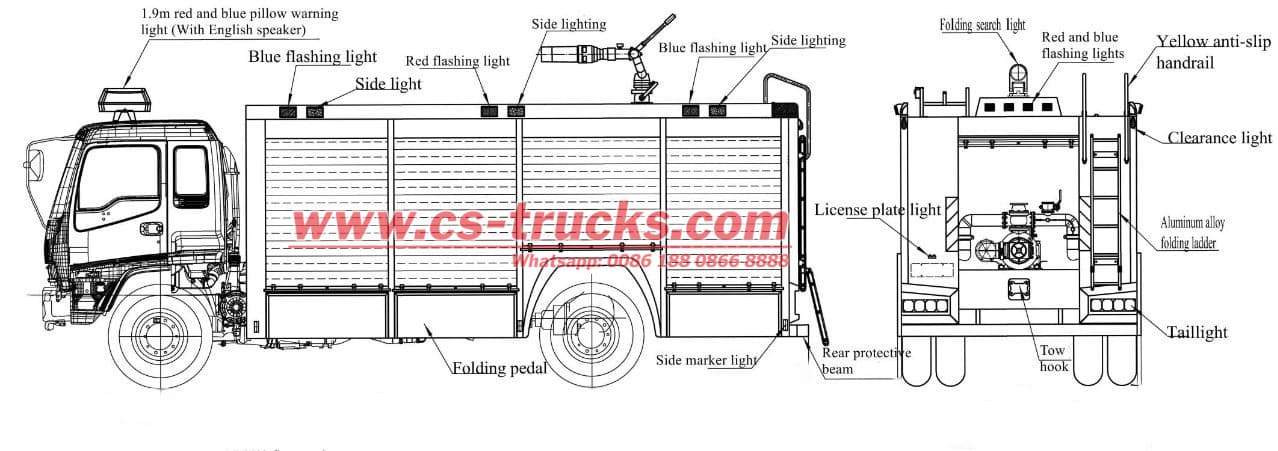
📌Special Note: A larger chassis does not necessarily mean stronger firefighting capabilities. The actual firefighting performance of a foam fire truck also depends on the fire pump, foam proportioning system, foam cannons, and overall system configuration.
Conclusion: Which is Better?
4×2 and 6×4 foam fire trucks each have their advantages. There is no absolutely better model. The key is whether it meets the actual firefighting needs.
- Choosing a 4x2 foam fire truck: If a compact, relatively inexpensive, and highly maneuverable fire truck is needed, primarily for use in urban areas, small to medium sized factories, warehouses, and general industrial parks, a 4x2 model is generally more suitable.
- Choosing a 6x4 foam fire truck: If a larger liquid capacity and stronger driving capability are required, primarily for use in large industrial parks, petrochemical plants, and oil storage tank areas, a 6x4 model is usually a better consideration.
The final selection should be based on a comprehensive assessment of the firefighting mission, tank capacity, road conditions, chassis load-bearing capacity, and procurement budget.
If you are looking for a foam fire truck suitable for your project needs, you can select the chassis drive type based on the actual usage scenario and further determine the water tank capacity, foam liquid tank capacity, fire pump flow rate, and foam cannon configuration.