

In waste collection and transportation, two of the most common vehicle types are the dump truck and the garbacompactor truck. Although both are designed to carry garbage, their operating principles differ significantly. Understanding these differences helps in selecting the appropriate vehicle for specific waste management requirements.
We will examine the main differences between dump trucks and compactor trucks in this article, focusing on structure, working principles, odor control, and practical applications.
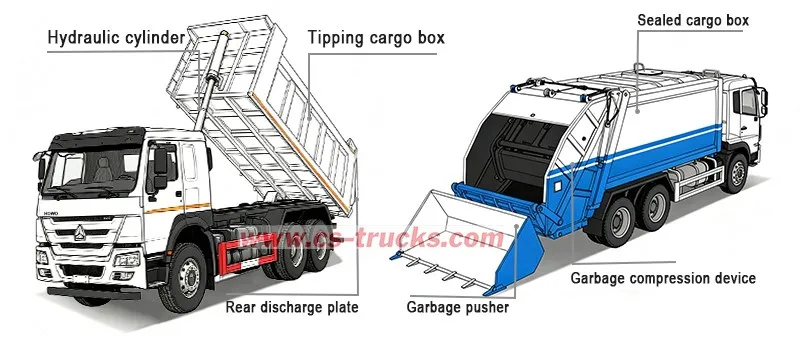
I. What Is a Dump Truck?
A dump truck is a conventional vehicle used for transporting loose materials such as soil, gravel, sand, and construction debris. Its most distinctive feature is a hydraulic lifting system that raises the front of the bed, allowing the load to slide out through the rear.
Common applications of dump trucks:
- Construction sites
- Mining operations
- Bulk material transport
- Heavy, non-compressible waste
Dump Truck Structure and Appearance
A dump truck has a relatively simple design. The main body consists of an open-top bed made of thick steel plates. The bed mounts on a chassis with a hydraulic cylinder attached to the front. When the cylinder extends, it lifts the entire bed and tilts it backward.

Key visual characteristics of a dump truck:
- Open top (most models lack a roof or cover)
- Visible hydraulic cylinder at the front of the bed
- Simple box-shaped bed
- Tailgate with bottom-mounted hinges
- No compaction mechanism
Dump Truck Working Principle
The dumping process consists of four stages:
1. Preparation: The power take-off (PTO) engages and starts the hydraulic pump. Oil flows from the pump through the distribution valve and returns to the tank.
2. Lifting: The directional control valve closes. High-pressure oil enters the cylinder, pushes the piston, and lifts the carriage.
3. Holding: The PTO disengages, and the pump stops. A check valve locks the oil inside the cylinder, keeping the carriage in position.
4. Lowering: The return oil line opens. Oil in the lower chamber of the cylinder returns to the tank, allowing the carriage to lower slowly and smoothly by gravity.

Three basic components of the dumping system:
- Dumping mechanism: carriage, subframe, hinge pins, and lifting rod mechanism
- Hydraulic drive system: PTO, drive shaft, hydraulic pump, piping system, lifting cylinder, and distribution valve
- Accessory system: safety props, lift limiters, automatic tailgate opener, carriage guide plates, and subframe connectors
II. What Is a Compactor Truck?
A compactor truck, also known as a garbage compactor or waste compression truck, is a specialized vehicle designed to collect, compress, and transport municipal solid waste. It features a built-in hydraulic compaction system that crushes waste inside a sealed body, allowing the truck to carry significantly more garbage than a dump truck of the same size.

Common applications of compactor trucks:
- Residential waste collection
- Commercial garbage services
- Municipal sanitation departments
- Recycling centers
Compactor Truck Structure and Appearance
A compactor truck differs significantly from a dump truck in appearance. The waste container is fully enclosed - a sealed steel body with no open top. At the rear, a hopper receives garbage for loading. A hydraulic-powered compaction plate pushes waste from the hopper into the main body.

Key visual characteristics of a compactor truck:
- Fully enclosed, sealed body
- No visible hydraulic cylinder on the exterior
- Rear-loading hopper with a lifting mechanism for bins
- Smooth, cylindrical, or rectangular body design
- The compaction mechanism is concealed inside the body
Compactor Truck Working Principle
The compaction process is driven by hydraulic oil, high-pressure lines, an oil pump, control valves, an electronic control system, and cylinders working in coordination. Power originates from the engine and transmits through the PTO.

Five main actions of a compactor truck:
1. Tipping plate tipping and retracting
2. Sweeping plate opening and closing
3. Sweeping plate lifting and lowering
4. Push plate retracting and extending
5. Rear lifting and locking
Loading and compression process:
When garbage enters the rear loading hopper, the cycle initiates. Four cylinders at the rear automatically activate to squeeze the garbage and push it into the body. At the start of operation, the hydraulic push plate inside the body should be positioned at the rear, approximately 50 cm from the rear opening. This configuration enables two-way compression of garbage for improved results.
As garbage continues to be squeezed and filled, the push plate gradually moves forward under pressure until it can no longer move. This creates two-way compression and evenly fills the entire body.
Unloading process:
When unloading garbage, the rear lifts first. The push plate then operates to move from the front to the back, pushing the garbage out of the body. After unloading completes, the rear lowers. Both rear lifting and push plate operation are electronically controlled.
Compactor Truck Functions and Advantages
› Bag breaking and compression: Reduces the number of garbage collection and transport trips, directly lowering operational costs
› Automatic disinfection and deodorization: Eliminates mosquitoes, flies, pests, and bacteria
› Easy operation: Automatic feeding, compression, storage, and unloading - collection personnel never need to contact the garbage directly
› Double-layer sealed structure: Garbage is completely sealed; no wastewater overflows; prevents disease vectors such as mosquitoes and rodents
› Compression ratio: High compression ratio for general household waste
› Safe storage: Fully enclosed design eliminates fire risk
III. Key Differences Between Dump Trucks and Compactor Trucks
Structure and Appearance
|
Feature |
Dump Truck |
Compactor Truck |
|
Body type |
Open top |
Fully enclosed |
|
Hydraulic cylinder |
Visible at front |
Concealed inside |
|
Compaction mechanism |
None |
Built-in |
|
Tailgate |
Hinged at bottom |
Sealed rear hopper |
|
Load visibility |
Visible from outside |
Not visible |
Working Principle
|
Aspect |
Dump Truck |
Compactor Truck |
|
Power source |
PTO drives hydraulic pump |
PTO drives hydraulic system |
|
Loading method |
Manual or mechanical loading |
Automatic bin lifting |
|
Compression |
No compression |
Hydraulic compaction |
|
Unloading method |
Gravity tilt |
Push plate ejection |
|
Automation level |
Low |
High (fully automated) |
Odor Control
This represents one of the most significant differences between the two vehicle types.
Dump truck odor characteristics:
- Open top allows continuous odor escape
- No seal on the tailgate
- Waste may include food scraps and wet garbage
- No compaction results in greater exposed surface area
Compactor truck odor control features:
- Fully enclosed steel body traps odors internally
- Rubber seals around the rear hopper prevent air leaks
- Compaction reduces trapped air volume
- The liquid drainage system collects leachate
- Automatic disinfection and deodorization system

IV. Conclusion
Dump trucks feature a simple, open-top design with a hydraulic lifting system. These vehicles are best suited for heavy, bulk materials such as soil, gravel, and construction debris. The open design allows odors to escape freely, making dump trucks unsuitable for household garbage collection in populated areas.
Compactor trucks feature a fully enclosed body with a built-in hydraulic compaction system. The sealed body contains odors internally, while the automatic compression mechanism enables the truck to carry up to three times more garbage than a dump truck of equivalent size. Additional features include automatic disinfection and deodorization, which prevent the spread of disease vectors such as mosquitoes and rodents.
When odor control and operational efficiency are priorities - particularly in residential and commercial areas - the compactor truck is the superior choice. For heavy loads of non-odorous materials, however, the dump truck remains a reliable and cost-effective solution.


