

In modern urban sanitation and commercial waste collection systems, the traditional fixed point garbage bin collection model generally suffers from pain points such as low loading rates, frequent transfers, odor nuisance, and high operation and maintenance costs. Today, the combined collection and transportation solution of hooklift garbage trucks and mobile garbage compactors has become the mainstream and efficient solution for sanitation companies, municipal projects, industrial parks, and large construction sites worldwide.

This article provides a detailed analysis of their efficient collaborative working logic, standard operating procedures, core value, and practical usage guidelines to help users maximize the operational efficiency of the entire system.
What Are Hooklift Garbage Truck And Mobile Garbage Compactor?
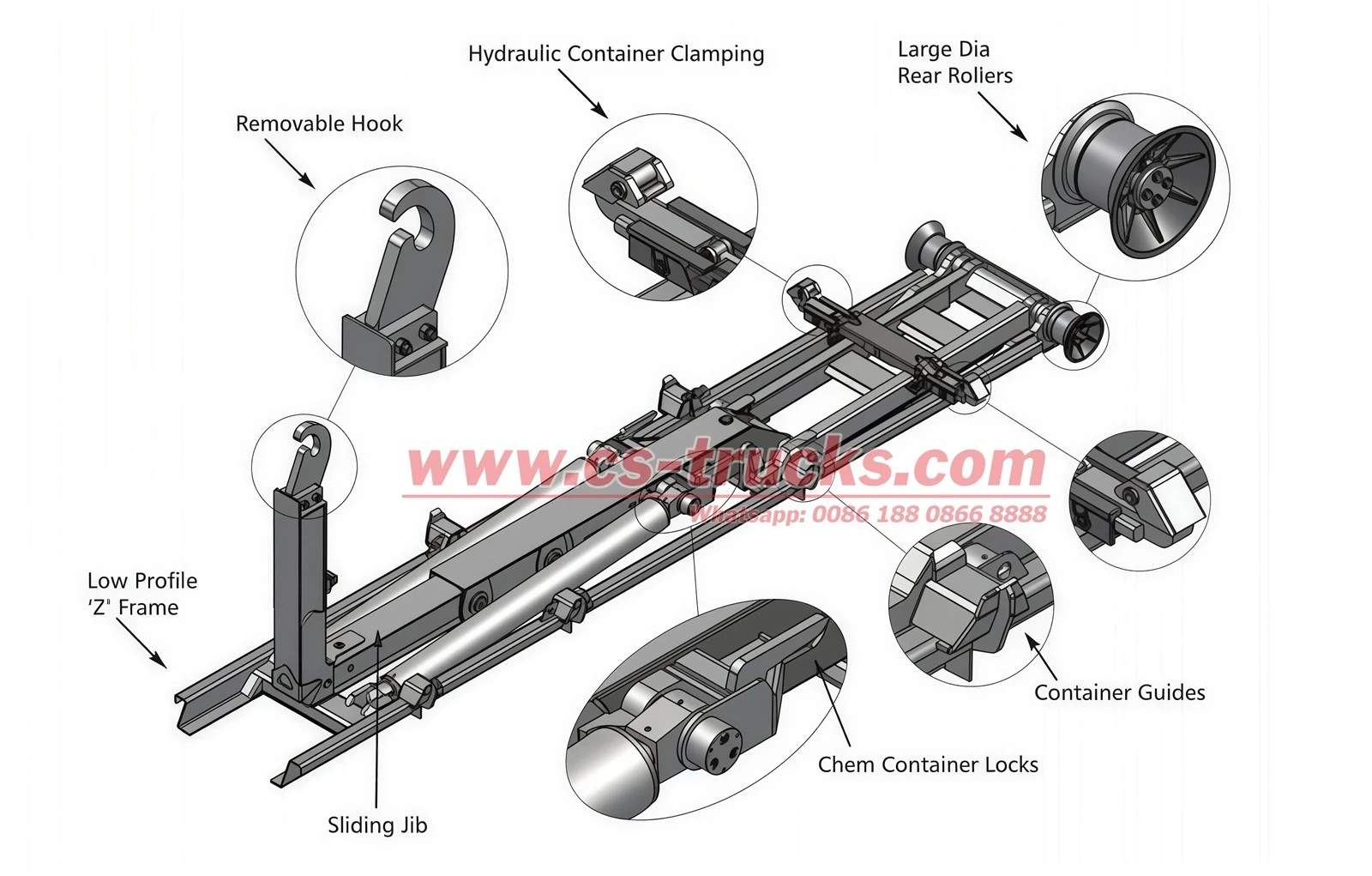
Hooklift Garbage Truck
This is a detachable container transport equipment that uses a hydraulic hook arm mechanism to lift, transport, and unload containers. It is only responsible for alternating between empty and full containers, supports single person wireless remote control, and allows one vehicle to serve multiple locations.
Mobile Garbage Compactor
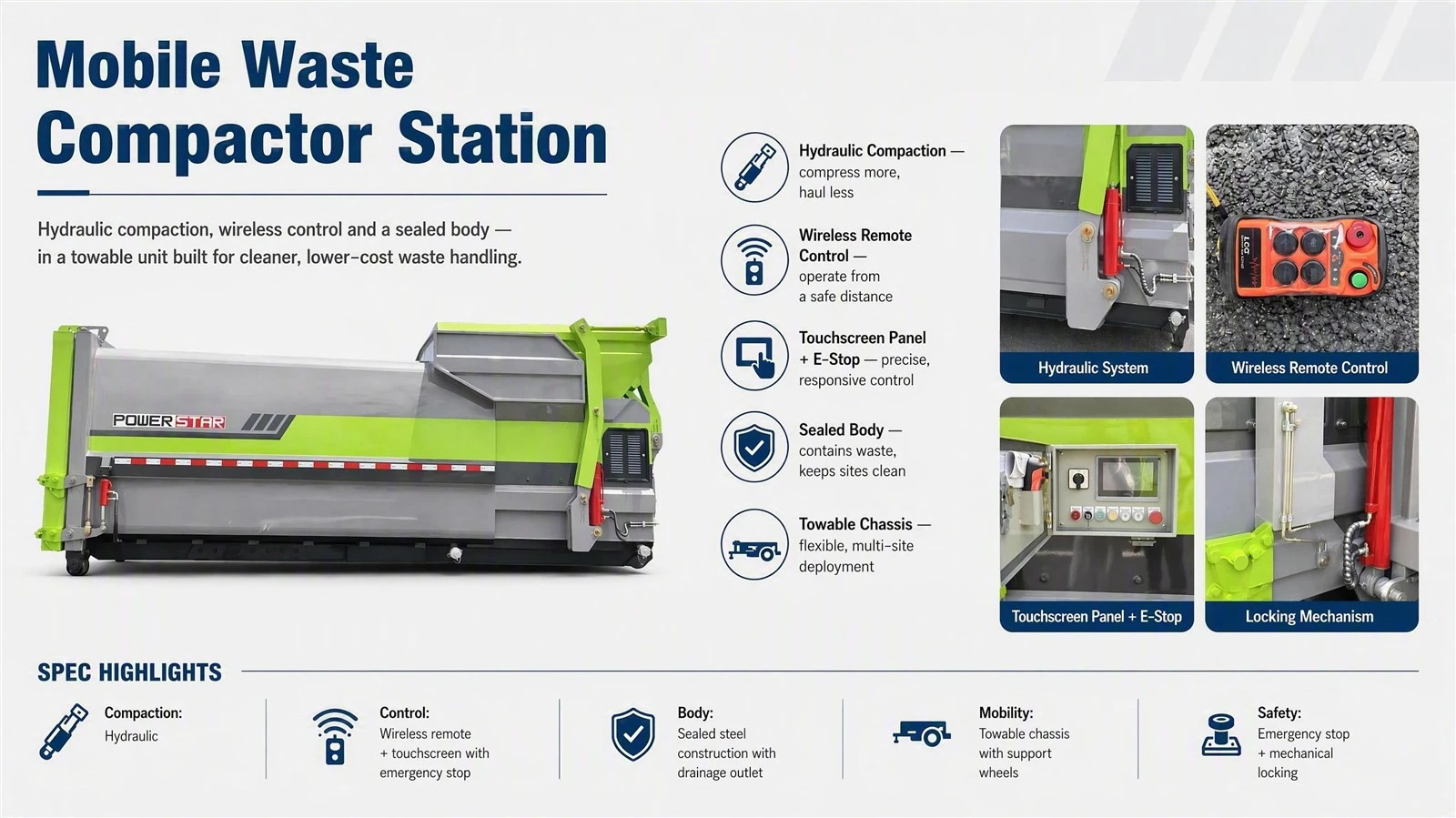
It integrates functions such as feeding, compression, sealed storage, and leachate collection. It can be deployed directly on the ground without the need for a civil engineering machine room, achieving waste compression and volume reduction at the source.
How Do Hooklift Garbage Trucks Work With Mobile Garbage Compactor?
1. Site Deployment, On Site Collection and Compression
Mobile garbage compactors are strategically deployed based on the area's waste production volume. Cleaning staff deposit waste into these stations, which automatically compress and store it. Leachate is collected centrally to prevent leakage along the way.
2. Full Load Warning, Unified Vehicle Dispatch
When a mobile garbage compactor reaches its maximum capacity, an alert is triggered. The dispatch center arranges a hooklift garbage truck to the designated site, eliminating the need for vehicles to remain stationary.
3. Rapid On Site Container Replacement
Once the hooklift truck is in position, a fully loaded garbage compactor is remotely lifted and loaded onto the truck, then the empty station is smoothly lowered to the ground. Each container replacement operation takes only 3-5 minutes, without affecting continuous waste collection.
4. Transfer and Unloading, Container Reuse
Fully loaded garbage compactors are transported to the treatment site for unloading, cleaning, and disinfection. Empty containers are returned to the area with the truck for the next cycle of operations.

Core Advantages Of Pairing A Hooklift Garbage Truck With A Mobile Garbage Compactor
1. Significantly reduce capacity and decrease the number of transfer vehicles
Ordinary loose waste has a high porosity and extremely low loading capacity. Mobile garbage compactor can compress waste to 2-3 times its density, reducing the number of transfer trips by more than half for the same amount of waste, significantly reducing fuel consumption, vehicle wear and tear, and labor costs.
2. Multi-container scheduling on a single vehicle maximizes equipment utilization
One hooklift truck can serve multiple compression boxes and multiple work sites. The vehicle is no longer idle at a single point, but can realize dynamic transportation in a roving manner, which greatly improves the utilization rate of the vehicle and reduces the customer's equipment procurement investment.
3. Fully enclosed operation, environmentally compliant
The entire process of garbage disposal, from collection to compression, storage, and transfer, is completely enclosed, effectively preventing odor spread, exposed garbage, and rainwater runoff and leachate pollution. It is fully compatible with the strict sanitation and environmental protection standards of various countries and is suitable for high-standard scenarios such as residential areas, schools, business districts, and scenic spots.
4. No civil engineering required, rapid deployment
The entire system requires no infrastructure renovation or fixed station building; it can be put into operation as soon as the equipment is brought to the site and powered on. It is fast to deploy and highly flexible, making it very suitable for temporary projects, new areas, and township expansion sanitation projects.
5. Mechanized operations reduce reliance on manual labor
Say goodbye to the traditional manual bin handling and frequent collection mode, significantly reduce the number of front line sanitation workers, reduce labor intensity and operational safety risks, and adapt to the modern sanitation outsourcing operation model

How To Choose The Appropriate Tonnage?
| Hooklift Garbage Truck Rated Tonnage | Adaptable to Mobile Garbage Compactor Volume | Applicable Scenarios |
| 5 Ton | 3m³-5m³ | Small communities, towns, commercial streets |
| 8 Ton | 6m³-8m³ | Medium sized industrial parks and residential areas |
| 12 Ton | 10m³-12m³ | Large industrial parks, densely populated urban areas, and scenic areas |
⚠️Note: When selecting a model, the weight of the enclosure itself plus the total weight under full load must be calculated. Overloading is strictly prohibited. The specifications of the lifting lugs vary between different manufacturers, so it is advisable to purchase complete sets to ensure compatibility.
Recommended Quantity Ratio
- High Density Waste Areas: 1 hooklift truck paired with 5-6 mobile garbage compactors
- Stable Areas Such as Industrial Parks and Towns: 1 hooklift truck paired with 8-10 mobile garbage compactors
What Key Points Should Be Paid Attention To During Operation?
1. Site Requirements
The work site must have a firm and level surface, allowing sufficient space for vehicle reversing and turning. For soft soil, simple hardening is recommended to prevent the container from tilting during hoisting.
2. Container Structure Selection Based on Needs
Standard sealed containers are used for general household waste; large capacity leak proof collection tanks are used for kitchen waste, sludge, and other highly leachable materials; wear resistant and reinforced containers are used for construction waste.
3. Compliance Configuration
For markets in Southeast Asia, Africa, Europe and the United States, remote material level monitoring, deodorizing sprays, and nighttime warning devices can be added to meet local environmental and road regulations.
4. Routine Maintenance and Management
Regularly inspect the hook boom hydraulic lines, compression cylinders, and container sealing strips; promptly drain leachate to reduce container corrosion and extend equipment lifespan.
Applicable Scenarios
Hooklift garbage trucks and mobile garbage compactors work together as a complete system, widely used in various solid waste collection and transportation projects, mainly including:
Municipal and Regional Sanitation
- Integrated Urban and Rural Sanitation Projects
- Township Waste Collection and Transportation Management Projects
- Municipal Sanitation Bidding Projects
Commercial and Residential Areas
- Large scale commercial complexes
- University campuses
- Large residential community clusters
- Tourist attractions
Industrial and Temporary Work Sites
- Industrial Park
- Temporary Solid Waste Collection Point at Construction Site

Conclusion
The combination of hooklift garbage trucks and mobile garbage compression stations represents the most cost effective, efficient, and environmentally friendly market based waste collection and transportation solution currently available. Through source compression and volume reduction, multipoint distributed storage, and mobile transport, it effectively addresses industry pain points such as waste accumulation, frequent transfers, high operating costs, and failure to meet environmental standards. It is compatible with the vast majority of municipal and private sanitation projects worldwide.


