

A water sprinkler truck, also referred to as a water tanker or spraying vehicle, is a versatile piece of equipment widely used in urban and environmental operations. It is suitable for tasks such as road sprinkling, dust suppression, surface cleaning, cooling, landscaping, emergency firefighting, and potable water transport. Essential components comprise the chassis, tank, water pump, valves, piping, and sprinkling system.

I. Detailed Structure and Functional Description
1. Chassis
The specialized vehicle chassis typically employs a high-performance, reliable, and robust platform. It offers strong load-bearing capacity, excellent compatibility, and lays a solid foundation for the vehicle's stable operation.
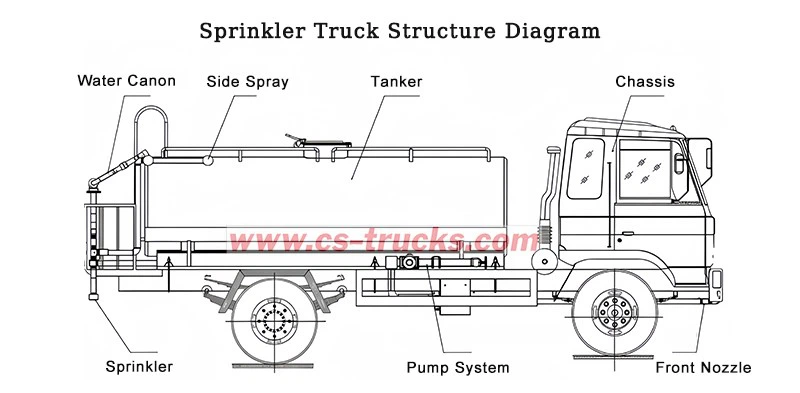
2. Tank Structure
The tank is constructed from high-quality carbon steel plates using advanced automated production line processes (including blanking, automatic panel welding, head spinning, and one-time tank body rolling), ensuring strength and sealing integrity. 304 stainless steel material can be optionally configured for special requirements.
- Shape and Compartmentalization: The tank is designed in an elliptical or square shape, with the internal water compartment usually divided into 2-3 chambers. Baffle plates between chambers have openings at their lower ends. This compartmentalized baffle design effectively acts as a surge suppressor, significantly reducing liquid sloshing and impact inside the tank during vehicle movement.

- Protection and Indication: To prevent corrosion, the tank's exterior is coated with anti-rust paint and decorative paint. A volume indicator is installed in the middle of the tank's side. This allows for intuitive reading of the remaining tank capacity during filling or discharging, facilitating convenient operation.
- Tank Filling Port Assembly: The main cover is secured to the port neck plate with bolts and is connected via a pivot pin to a smaller protective cover equipped with a handle. Rotating the small cover's handle clockwise presses it into a tight seal. Rotating it in reverse and disengaging the lug allows the small cover to be opened. The main cover has a Φ30 ventilation hole to ensure pressure equilibrium between the tank interior and atmospheric pressure during the filling process.

3. Piping and Operating System
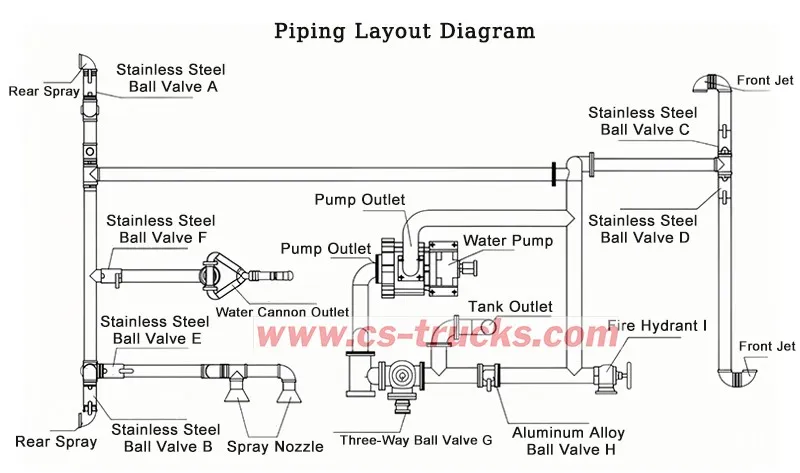
- Operating System Principle: The vehicle's power transmission path is: Engine → Gearbox → Power Take-Off (PTO) → Drive Shaft → Water Pump. The pump, when operational, generates the pressure to move liquid from the tank through the pipe network to the various spraying units.
- Power Take-Off (PTO): Equipped with a dedicated PTO matched to the vehicle model, operated either pneumatically or manually. To operate: Pull the control switch backward to engage the PTO, which drives the pump. Push the switch forward to its original position to disengage the PTO, stopping the pump. Crucial Reminder: Engagement and disengagement of the PTO must be performed only when the vehicle is completely stationary, the engine is running, and the gearbox is in neutral.
- Water Pump: The core component is a high-power, self-priming, impeller-type dedicated sprinkler pump. It features self-priming capability and comes with firefighting connections and a self-flowing valve. It offers a wide operating range: Self-priming height ≤7m, sprinkling width ≥14m, maximum range ≥28m.
- Ball Valves: Key components in the piping control system, consisting of the valve body, adjustment seat, sealing ring, ball, stem, and handle. Rotating the handle 90° achieves on/off operation. The fit tightness can be adjusted by rotating the adjustment seat. Specific ball valves (e.g., O-ring E in the diagram) control the operating mode: open for water intake, closed for sprinkling.

4. Sprinkler Configuration
The sprinkler truck is equipped with a comprehensive spraying system to meet different scenario requirements:
- Front: Fitted with duckbill nozzles or round flush nozzles for high-pressure road surface cleaning.
- Rear: Equipped with cylindrical sprinkler nozzles and optionally up to 8 auxiliary nozzles. A landscaping sprinkler cannon (water monitor) is installed on the rear work platform.
- Sides: Fitted with side-spraying showerheads (lotus head type).
- Function Adjustment: The spraying direction and angle of the sprinklers can be altered by adjusting the nozzle threads. The high-elevation spray gun (water cannon) has a long range and can be adjusted to a jet stream (range ≥28m) or a mist (range ≥15m) for uses like landscaping and emergency firefighting. The lotus head nozzles effectively wash down dust stirred up by the front sprinklers in the middle of the road, purifying the air.
II. Standard Operational Procedures Explained
(A) Pre-Use Preparation
1.Check the gearbox lubricating oil level; it should reach the lower edge of the oil level plug hole. Add specified gear oil if insufficient.
2.Confirm the gearbox control lever is in the neutral position.
3.Check the PTO control handle, ensuring it is in the disengaged position (typically horizontal to the right).
4.Adjust the throttle controller to its minimum position.
(B) Water Refilling Methods
Method A: Direct Water Supply from Tap/Mains
1.Drive the vehicle to the predetermined location, aligning the tank filling port with the water main outlet.
2.Open the tank port cover.
3.Connect the water hose, open the water supply valve, and begin direct filling. Monitor the water level using the tank volume indicator.
Method B: Self-Priming Water Intake from Field Sources
- Preparation and Connection: Park the vehicle as close to the water source as safely possible. Connect the suction hose to the three-way ball valve G. Insert the suction hose end (with filter screen) as deeply as possible into the water, ensuring the end remains at least 300mm below the water surface at all times. Adjust the three-way ball valve G handle to the "Intake" position (refer to diagram; the recessed direction typically indicates the closed flow path).
- Valve Status Setting: Close all operational ball valves (A, B, C, D, E, F) and the fire hydrant I. Open the aluminum alloy ball valve H leading to the water tank.
- Starting the Pump: Start the engine. Slowly and smoothly release the clutch pedal to initiate pump operation. The pump speed can be regulated via the throttle controller.
- Monitoring and Stopping: Observe the tank volume indicator. Once the tank is full, set the throttle controller to minimum, depress the clutch pedal, return the PTO control switch to its original position to disengage, stopping the pump. Close ball valve H and remove the suction hose.
Water Flow Path: Water Source → Three-way Ball Valve G → Filter Screen → Pump → Aluminum Alloy Ball Valve H → Water Tank.
(C) Sprinkling Operation
1.Initiating Sprinkling: Connect the relevant sprinkling pipelines. Based on requirements, open the corresponding sprinkling ball valves (e.g., front flush, rear spray, side spray, showerhead, or cannon). Start the engine, depress the clutch, engage a driving gear (low gear), then pull the PTO switch backward to engage the PTO and slowly release the clutch. The pump begins operating, initiating sprinkling.
2.Stopping Sprinkling: Upon completion of sprinkling or when the tank is empty, first push the throttle controller to minimum, depress the clutch pedal, push the PTO control switch forward to disengage, and then proceed with regular vehicle operation.
(D) Post-Use Checks
1.Confirm the PTO control switch is fully returned (disengaged).
2.Check that the throttle controller is in the minimum position.
3.Inspect that the handles of all valves (ball valves) are in the closed position.
III. Important Precautions and Maintenance
1.Water Source Requirements: When using streams or ponds as water sources, ensure the suction hose end is fully submerged. Never remove the filter assembly for water intake. If the source is shallow, deepen the intake point beforehand to avoid drawing in air and debris. Note the different water quality requirements for clear water pumps versus turbid water pumps.
2.Pump Priming: Self-priming pumps require initial priming on first use. Subsequent use generally does not require repriming if the pump retains some water.
3.Piping Seal: During water intake operations, the inlet pipe system must maintain a sealed vacuum state. Regularly inspect hoses for damage and rigid pipes for cracks to prevent air leaks that would hinder water suction.
4.Winter Freeze Protection: Before the onset of cold weather or during extended periods of inactivity, completely drain all water from the pump, water pipes, and tank to prevent freezing and cracking of components.
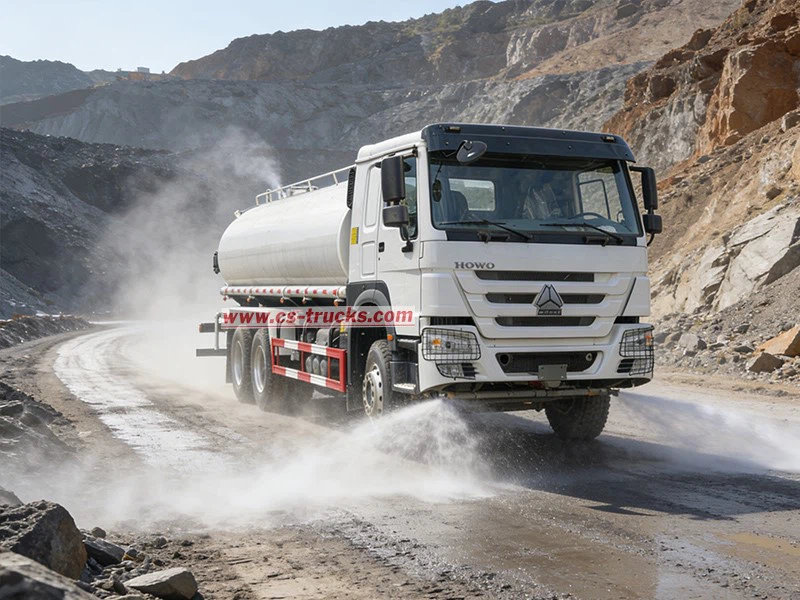
5.Sprinkling Techniques: Front nozzles have high pressure, suitable for flushing; rear nozzles provide wide coverage, suitable for dust suppression sprinkling. When using adjustable nozzles, pay attention to adjusting the spray width and overlap to achieve uniform sprinkling density.
6.Regular Maintenance:
- Lubrication and Tightening: Regularly lubricate all lubrication points on the drive train and frequently check and tighten connection points.
- Regular Sediment Drainage: A drain pipe is installed at the bottom of the water tank. Periodically open the drain valve to expel accumulated sediment from the tank until the water runs clear, protecting the pump and piping system.

IV. Optional Configurations and Services
Our CS sprinkler trucks offer a rich selection of optional configurations to meet personalized user needs, including but not limited to: GPS systems, universal nozzles, solenoid/pneumatic valves, visual operating systems, external power connections, chemical tanks and sprayers (for pesticide application), special anti-corrosion coatings inside the tank, multi-directional inlet/outlet connections, and truck-mounted cranes. We are committed to providing the most suitable solutions for our clients.


