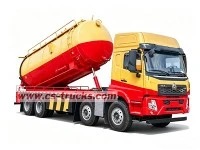
The vehicle-mounted fire monitor is the core firefighting device of a fire truck, and its range, spray accuracy, and atomization effect directly determine the efficiency of firefighting operations. Fire protection maintenance and municipal vehicle fleets often encounter problems such as insufficient range, spray deviation, abnormal mode switching, and ineffective long distance firefighting, which are mostly caused by improper adjustment, pressure mismatch, and wear and tear of parts.

Based on the general technical standards for exported fire trucks, this article simplifies and summarizes the standardized range adjustment process, mode switching techniques, and pressure matching rules for vehicle-mounted fire monitors. It also summarizes common misconceptions, troubleshooting, and daily maintenance solutions, and is compatible with both manual and electrically controlled fire monitors. It is suitable for users' daily operation and equipment maintenance reference.
I.Key Factors Affecting Fire Monitors Range
To precisely adjust the range, it is essential to understand the key factors that affect it; all calibration procedures are centered on the following key points:
- Fire Pump Outlet Pressure: Range is positively correlated with pump pressure and insufficient pressure is the primary cause of short range. Different vehicle models have different rated working pressures.
- Nozzle Condition And Specifications: Nozzle diameter determines the basic range. Blockage, wear, and deformation will directly cause water flow dispersion and range reduction.
- Spray Mode: Direct spray mode is mainly for long distance fire suppression, while atomization mode focuses on large area coverage. The range difference between the two modes is significant.
- Pipeline Flow Capacity: Filter screen buildup, valves not fully open, and pipe blockages and leaks will lead to insufficient flow and limited range.
- Spray Elevation Angle: There is an optimal angle range. An excessively high or low elevation angle will significantly reduce the effective spray range.

II.How To Adjust The Range Of The Fire Monitor
Currently, fire trucks are primarily equipped with manual fire monitors and electronically controlled remote controlled fire monitors. The adjustment logic for both is the same. The following are the general, standardized commissioning steps:
1. Pre-operation Equipment Inspection
Perform a pre-operation check: Verify that the power take off (PTO) and fire pump are operating normally, and that the main water valve and the monitor's inlet valve are fully open; clear any debris from the nozzle and filter screen; and check that the monitor's elevation and rotation mechanisms are free of jamming or looseness.
2. Match the Operating Pressure of The Fire Pump
Pump pressure is the key factor determining spray range: For direct fire suppression at long distances, adjust the pump pressure to the rated range of 0.8–1.2 MPa; for cooling and blanket fire suppression at close range, adjust the pressure to 0.4–0.6 MPa. Do not operate at excessive pressures for extended periods to prevent pipe rupture, seal leakage, and pump overload damage.
3. Switch Spray Modes to Control Range
The fire monitor features a dual mode switch to accommodate different range requirements:
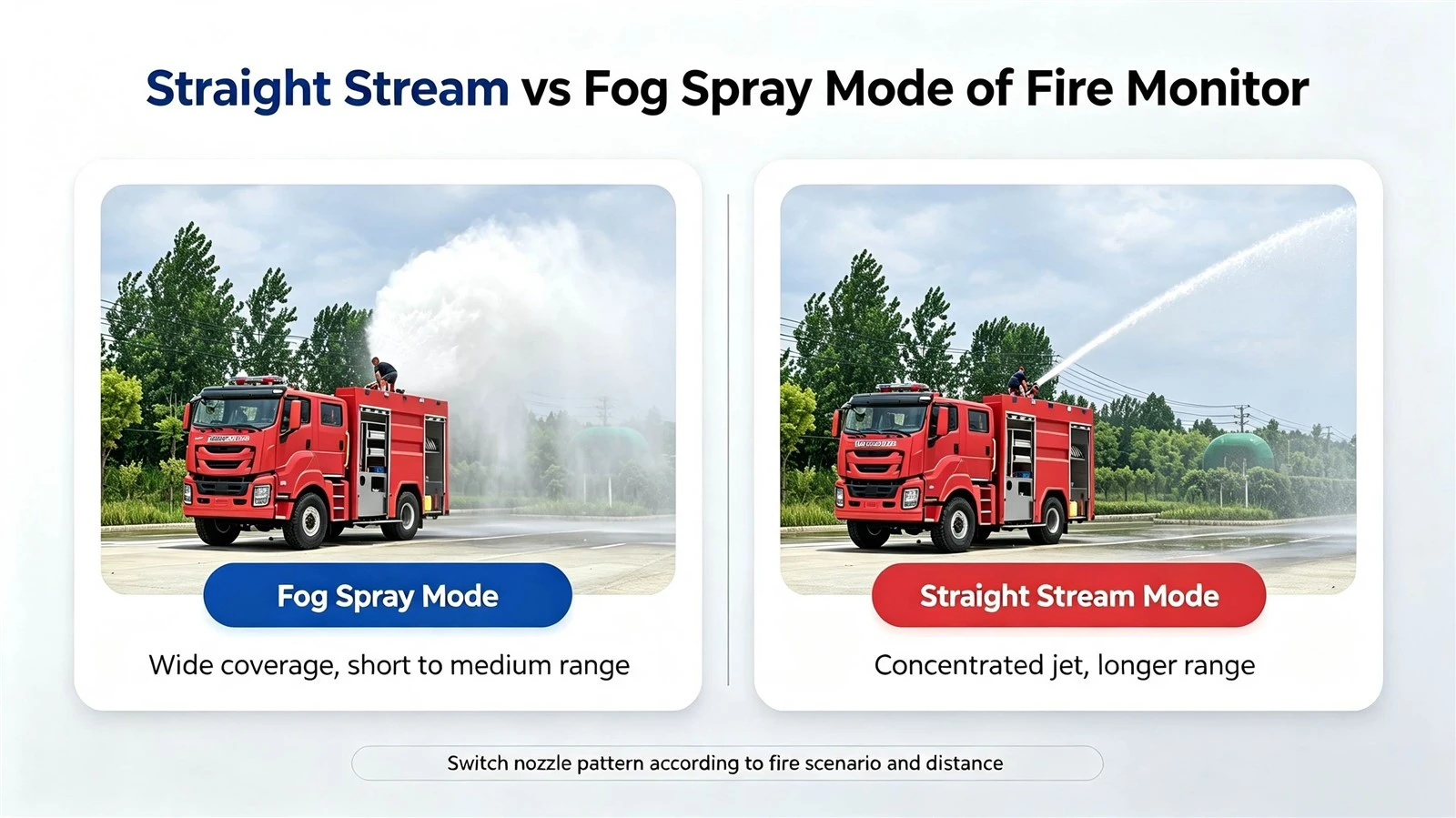
- Direct Spray Mode (Long Range): Tighten the nozzle knob to concentrate the water flow, producing a columnar spray with an effective range of 35–55 m; suitable for high rise buildings and distant fire sources.
- Mist Mode (Short Range): Loosen the knob to disperse the water flow, creating a mist coverage with an effective range of 10–25 m; suitable for early stage fires and cooling large areas.
4. Adjust Vertical Elevation for Maximum Jet Distance
The optimal vertical angle is 30°–45°, which minimizes water loss due to the parabolic trajectory and thus achieves the maximum range.
- Angles greater than 60°: The water stream scatters in the air, causing the effective range to decrease sharply.
- Angles less than 15°: The water splashes onto the ground and cannot be used for firefighting in high rise buildings.
After adjustment, lock the pitch mechanism to prevent the angle from shifting during operation.
5. Fine-tuning of the Horizontal Angle
Manual cannons rotate the barrel directly, while electronically controlled cannons use a remote control to fine-tune the horizontal angle for precise targeting of the fire source; for large scale fires, the cannon can swing back and forth slightly to balance range and coverage area.
III.Extra Fine-Tuning Function of Electric Intelligent Fire Monitors
The high end fire trucks are equipped with an electronically controlled intelligent fire monitor that supports precise range adjustment. Water flow and pressure levels can be switched with a single button via the vehicle panel or wireless remote control. Combined with the constant pressure control system, it automatically stabilizes the pressure, completely eliminating fluctuations caused by manual pressure adjustment, ensuring accurate and stable range throughout the entire process, and fully meeting the needs of high standard emergency firefighting scenarios.

IV.Common Range Adjustment Mistakes
| Common Mistakes | Consequences of Mistakes | It should... |
| Blindly increasing pressure to extend range | Accelerates pipeline deterioration, causes leaks, and leads to pump overload failures | Adjust according to the rated pressure range; do not operate at pressures exceeding the rated range for extended periods |
| Forcing long range spraying in atomization mode | Water splashes everywhere, and firefighting efficiency is low | Switch to direct spray mode for long range fire suppression; use mist mode for close range cooling and coverage |
| Neglecting to clean nozzles and filters | Insufficient flow, range degradation (common hidden faults) | Clean the nozzle and filter screen promptly after use, and inspect and replace them regularly |
| Spraying at extreme angles | Significant loss of effective range, preventing the equipment from performing at its rated capacity | Maintain an optimal pitch angle of 30°–45° and lock the pitch mechanism |
V.Troubleshooting: How to Fix Insufficient Jet Range
| Troubleshooting Steps | Inspection Content | How to Solve |
| Pressure Calibration | PTO Engagement Status, Fire Pump Operating Conditions | Ensure that the operating pressure reaches the equipment's rated value, and inspect the power take off unit and the fire pump |
| Water System Cleaning | Clogged filters and nozzles; worn or deformed nozzles | Disassemble and clean the filter screen and nozzles; replace worn or deformed nozzle parts |
| Piping Inspection | Valve opening, pipe bends, blockages, and leaks in the water system | Open all water valves, repair bent or blocked pipes, and handle leaks and pressure relief |
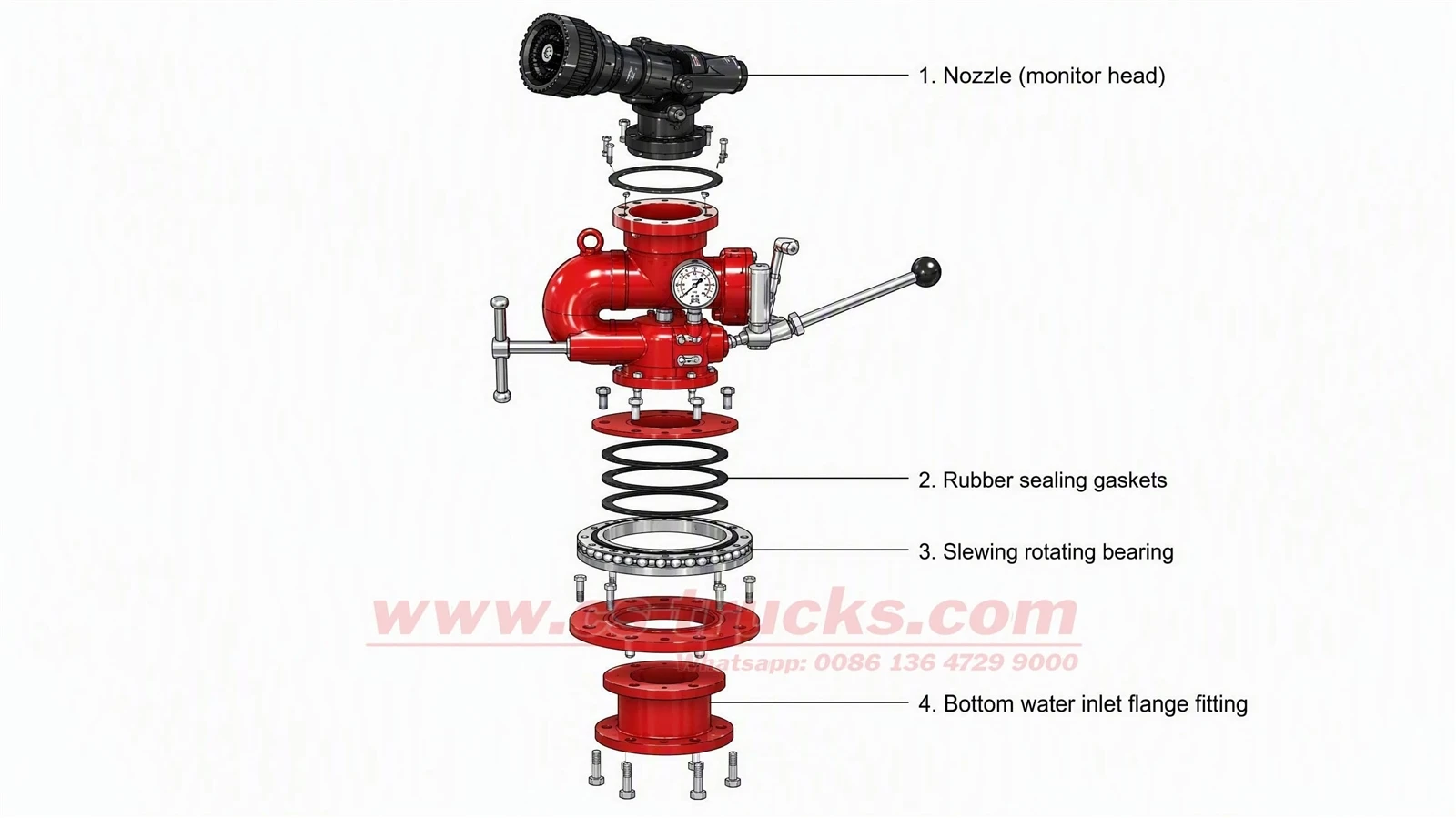
| Seal Replacement | Aging of the sealing gasket in the monitor body, causing pressure leakage and water seepage | Regularly replace the sealing gaskets to resolve pressure relief and leakage issues, and restore the rated jet range |
| Electrical Control Parameter Calibration | Deviations in electronic control system parameters; circuit control malfunctions | Restart the system, calibrate pressure parameters, and troubleshoot circuit control faults |
VI.Daily Maintenance to Keep Stable Jet Range
Regular maintenance is key to ensuring the stability of a fire monitor's range:
- Rinse nozzles and filters after operation to prevent impurities from remaining.
- Lubricate rotary and pitch bearings monthly to ensure smooth adjustment.
- Check pump pressure and pipeline sealing quarterly, and replace worn parts promptly.
- In coastal salt spray environments, perform regular anti-corrosion treatment to prevent rust from affecting equipment accuracy.
VII.Frequently Asked Questions
Q: Where should you check first if a fire monitor fails to reach its rated range?
A: First, verify the operating pressure of the fire pump; second, check whether the nozzle and filter screen are clogged or worn.
Q: How should you choose between mist mode and direct jet mode?
A: Use direct jet mode for long distance, high rise fires; use mist mode for close-range cooling and initial stage fires.
Q: What causes a fire monitor to jam during rotation?
A: The rotation bearings are either lacking lubrication or corroded; simply apply specialized grease monthly.
Q: How should water leakage and pressure loss in the cannon body be addressed?
A: Disassemble the unit and replace any aged internal gaskets, while also checking the tightness of the bolts at the flange connections.
Q: What is the optimal spray elevation angle for a fire monitor?
A: 30°–45°; within this range, water loss is minimal and the spray distance is maximized.
VIII.Conclusion
Adjusting the range of a vehicle-mounted fire monitor involves a systematic process that includes pressure matching, mode switching, angle calibration, and adaptation to operating conditions. Proper commissioning maximizes the fire truck's firefighting performance, enables it to handle various complex fire scenarios, and simultaneously reduces equipment failure rates and extends service life. Firefighting operations and maintenance teams can rely on the standardized procedures outlined in this article to perform routine commissioning, troubleshooting, and periodic maintenance, ensuring the long term, stable operation of the equipment.