

When purchasing a vacuum sewage suction truck, tank volume and vacuum pump flow rate are two of the most critical technical parameters, directly determining the vehicle's operating efficiency, carrying capacity, and operating costs. Many customers focus only on tank size, neglecting vacuum pump performance, ultimately leading to problems such as slow suction speed and frequent equipment overload.
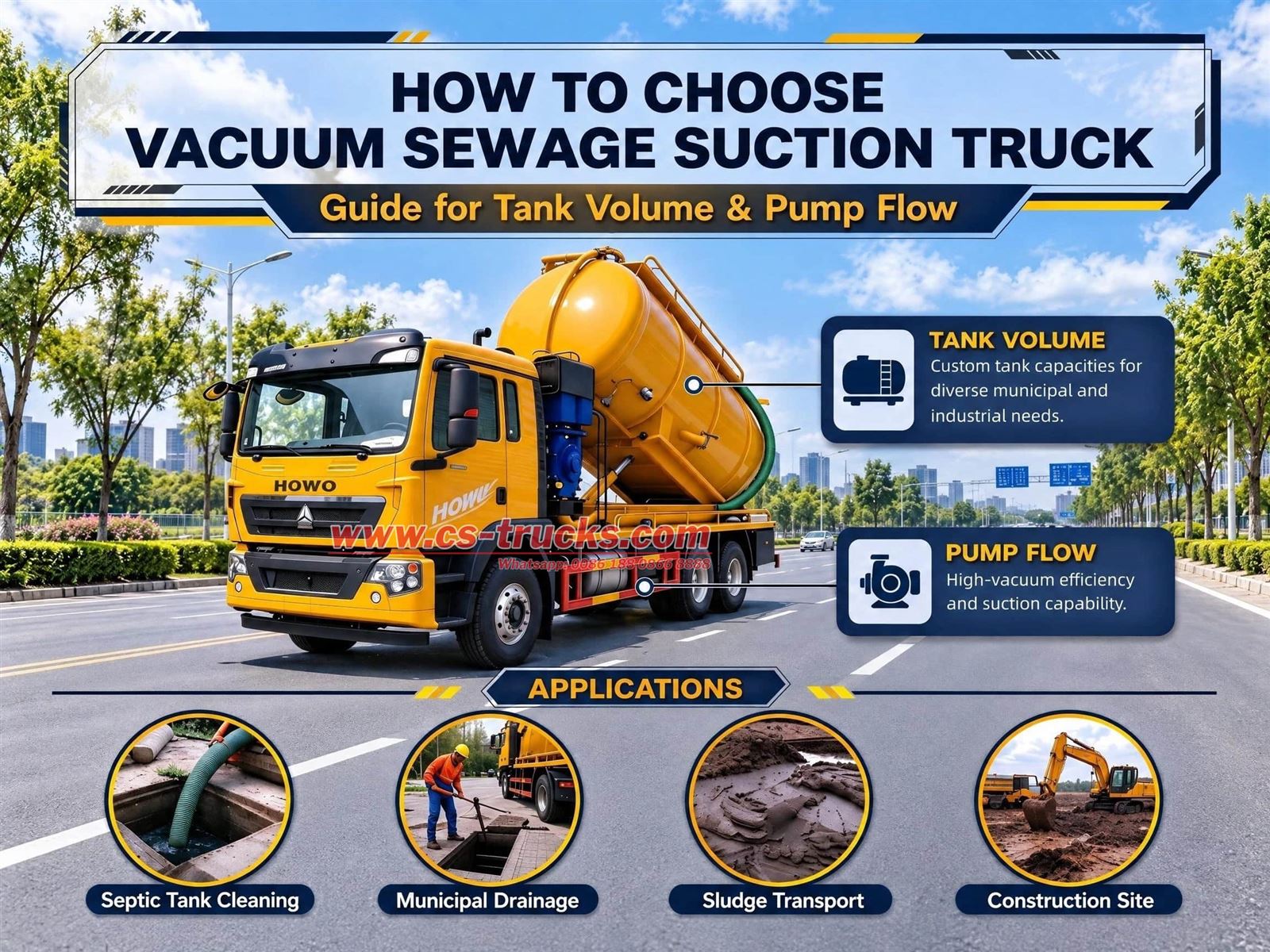
This article will break down how to match tank volume and vacuum pump flow rate based on actual working conditions, helping you select the right vacuum sewage suction truck.
How To Select The Tank Volume Of Vacuum Sewage Suction Truck
Tanks are containers for storing sludge, sewage, and mud waste. The selection of the appropriate volume depends primarily on the transportation distance, the characteristics of the waste, and road weight restrictions.
1) Short Distance Operations In Urban Areas
Applicable scenarios: municipal pipeline maintenance, residential septic tank cleaning, short cycle waste collection.
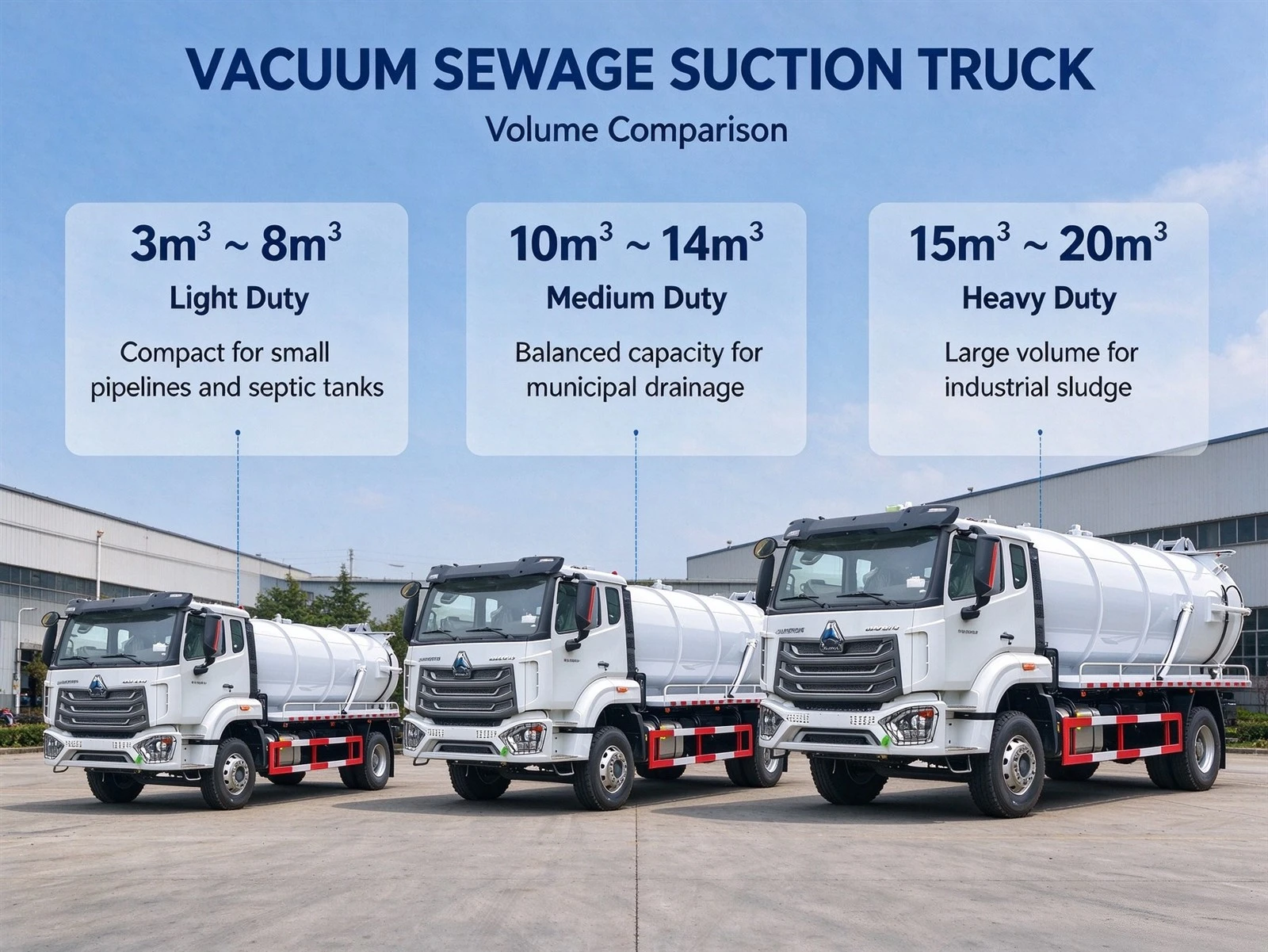
- Recommended tank volume: 3m³ ~ 8m³
- Advantages: Small turning radius, high maneuverability in narrow streets and alleys, and easier to meet urban road weight restrictions
- Suitable for: Low concentration sewage, thin sludge
2) Medium Sized Farm Operations In Rural Areas / Working Conditions Of Livestock Farms
Applicable scenarios: rural pipeline dredging, livestock and poultry farm manure collection, and periodic sludge removal.
- Recommended tank volume: 10m³ ~ 14m³
- Advantages: Balanced carrying capacity and mobility, reducing the number of transfers
- Suitable for: Medium viscosity sludge, mixed sewage
3) Long Distance, High Viscosity Heavy Sludge Operation Conditions
Applicable scenarios: construction site mud suction, large septic tanks, industrial sediment transfer
- Recommended tank volume: 15m³ ~ 20m³
- Precautions: Local axle load and gross weight limits must be strictly verified; large tanks have poor maneuverability in narrow roads.
- Suitable for: High viscosity thick sludge, high solids slurry
⚠️Important Reminder: Do not blindly pursue large tanks. If it is high density, thick sludge, the vehicle's weight will reach its maximum load limit before the tank is even full.
Vacuum Pump Flow Selection And Pump Type Comparison
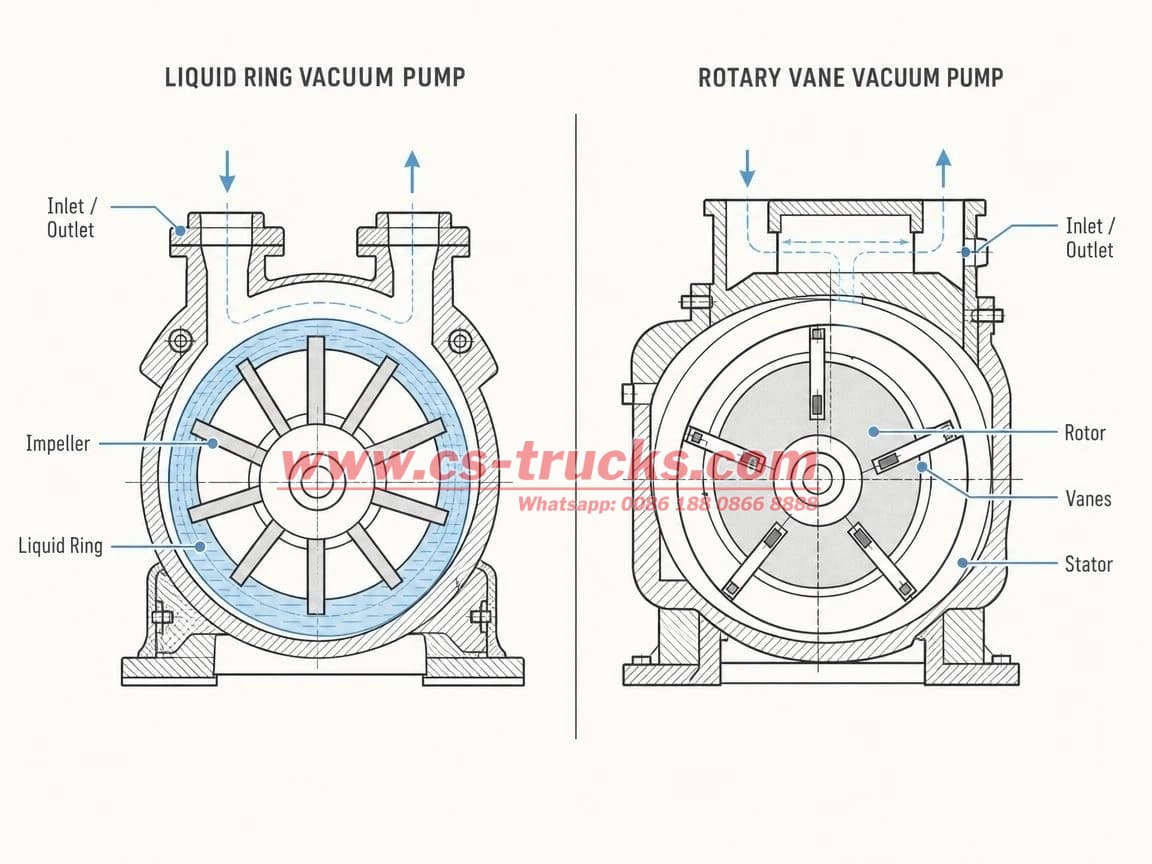
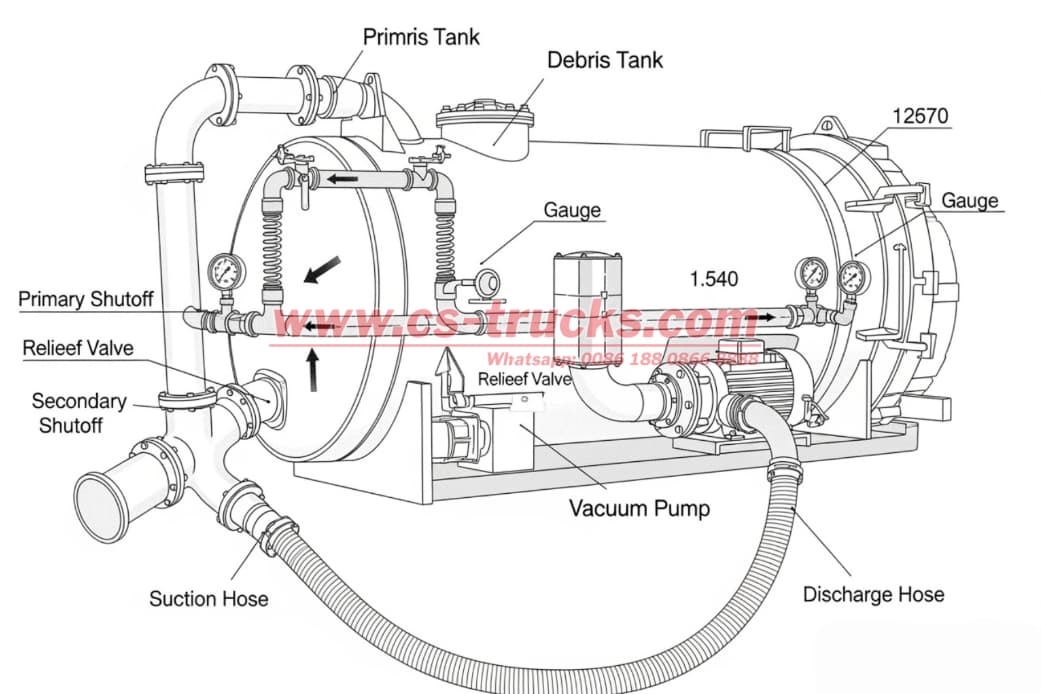
The vacuum pump is the "heart" of the vacuum truck, relying on creating negative pressure to suck the sewage into the tank. The flow rate (m³/h) determines the time it takes to fill the tank in a single pumping operation.
| Comparison Projects | Water Ring Vacuum Pump | Rotary Vane Vacuum Pump |
| Core Features | Stable negative pressure, low noise, and can withstand small amounts of water vapor | Fast suction speed, high vacuum, and no water required for operation |
| Recommended Traffic Range | 180~300 m³/h | 200~350 m³/h |
| Applicable Working Conditions | Wastewater, thin sludge, conventional septic tanks, municipal pipeline operations | Medium to high viscosity sludge, construction mud, and materials containing a large amount of solid particles |
| Limitation | Not suitable for dry, dusty materials; requires water supply during operation | Maintenance requirements are higher; large solid particles can easily cause damage if they enter the pump chamber |
Tank Volume And Pump Flow Rate Matching Reference
Tank volume and pump flow rate are not independent parameters; their matching degree directly affects the operating experience.
| Tank Volume | Recommended Pump Flow Rate | Applicable Scenarios | Matching Logic |
| 3–5 m³ | 60–80 m³/h | residential areas, towns, narrow streets and alleys | Small tanks do not require high pumping speeds; the key is vehicle maneuverability |
| 8–10 m³ | 80–120 m³/h | Municipal routine dredging and septic tank cleaning | Balancing fill time and equipment cost |
| 12–15 m³ | 120–180 m³/h | Large scale pipeline networks and industrial scenarios | Large tanks require high pumping speeds to avoid taking too long to fill |
| 18 m³ or more | 180–300 m³/h | Emergency drainage, industrial waste liquid | To maximize throughput per cycle, pump capacity must keep up |
Note: Using a large tank with a small pump results in excessively long pumping times and low daily output; excessively large pump flow rates increase procurement costs and fuel consumption, with little improvement in profitability.
Other Factors That Affect Your Selection
1. Sludge Viscosity And Solids Content
Thick sludge requires higher vacuum levels and greater pump flow rates; simply increasing tank size is insufficient.
2. Operating Pipeline Length
Longer suction hoses result in greater negative pressure loss, necessitating higher vacuum performance to compensate, but reducing suction capacity.
3. Local Road Conditions And Weight Restrictions
Many cities have strict limits on vehicle gross weight, which may prevent large capacity tanks from being registered.
4. Power Type
Diesel chassis are suitable for long distance operations; electric vacuum trucks are suitable for zero emission control areas in city centers.
Summary Of Selection Logic
| Step | Key Points Of Operation | Technical Specifications |
| Step 1: Identify the type of waste | Differentiate between dilute wastewater, medium grade sludge, and high viscosity thick sludge. | Thick sludge and high solids content materials require higher vacuum levels and pump flow rates; simply increasing the tank size is insufficient |
| Step 2: Calculate the workload | Statistics on daily collection and transportation trips and single transfer distances | Determine the tank volume; prioritize smaller volumes for short, narrow routes; select larger volume tanks for long distances and large workloads |
| Step 3: Parameter Matching | Match the vacuum pump flow rate according to the tank volume | The larger the tank, the greater the pump flow rate is required to ensure a reasonable pumping time |
| Step 4: Compliance Verification | Check local road weight limits, emission standards, and vehicle registration policies | Large tanks are heavy, and even when not fully filled with sludge, they can easily exceed the vehicle's weight limit |
📌Tip: When selecting a pump, do not only look at the tank volume or pump flow rate. You must consider the properties of the waste, the transportation conditions, and regulatory restrictions to make a comprehensive match.
Conclusion
The selection of a vacuum sewage truck essentially involves finding the optimal configuration between the economies of scale corresponding to the tank volume and the operational efficiency guaranteed by the pump flow rate. A configuration presented as "cost effective" on the parameter list will inevitably result in efficiency losses in actual operation if the pump flow rate is insufficient to match the tank volume, or if the chassis load bearing capacity does not match the total load mass.
For international trade procurement, using operational condition data rather than price tags as the starting point for selection is the most reliable method for controlling the entire life cycle cost.
Frequently Asked Questions
Q1: Does a larger tank necessarily mean higher operating efficiency?
A: No. When the sludge density is high, the vehicle's weight reaches its maximum load limit before the tank is even fully filled. Furthermore, large tanks have poor maneuverability in narrow passageways.
Q2: Is a higher vacuum pump flow rate always better?
A: Not necessarily. Excessive flow rate only increases procurement costs and equipment wear; it needs to be matched to the tank volume and sludge characteristics.
Q3: For high viscosity sludge operations, is simply increasing the vacuum pump flow rate sufficient?
A: Not enough. In addition to pump flow rate, sufficient vacuum is also required, along with shortening the suction pipe, reducing bends, and lowering negative pressure loss.
Q4: Can water ring pumps and rotary vane pumps be directly interchanged later?
A: No, they cannot be directly interchanged. The mounting bases, piping interfaces, and power matching of the two types of pumps are different. Replacing them requires modification of the hydraulic and transmission systems.
Q5: When purchasing a vacuum truck, should I prioritize tank capacity or vacuum pump specifications?
A: First, determine the type of wastewater being handled, then match the tank capacity, and finally, select the appropriate vacuum pump. The type of wastewater being handled is the top priority and should not be reversed.


