

The rear loader garbage trucks are the mainstream and core equipment used in municipal sanitation, industrial parks, and township cleaning operations. Compared to side loading and bin mounted models, they have become the preferred choice for sanitation procurement both domestically and internationally due to their high compression ratio, fully enclosed design, automated operation, wide adaptability, and low operating and maintenance costs.
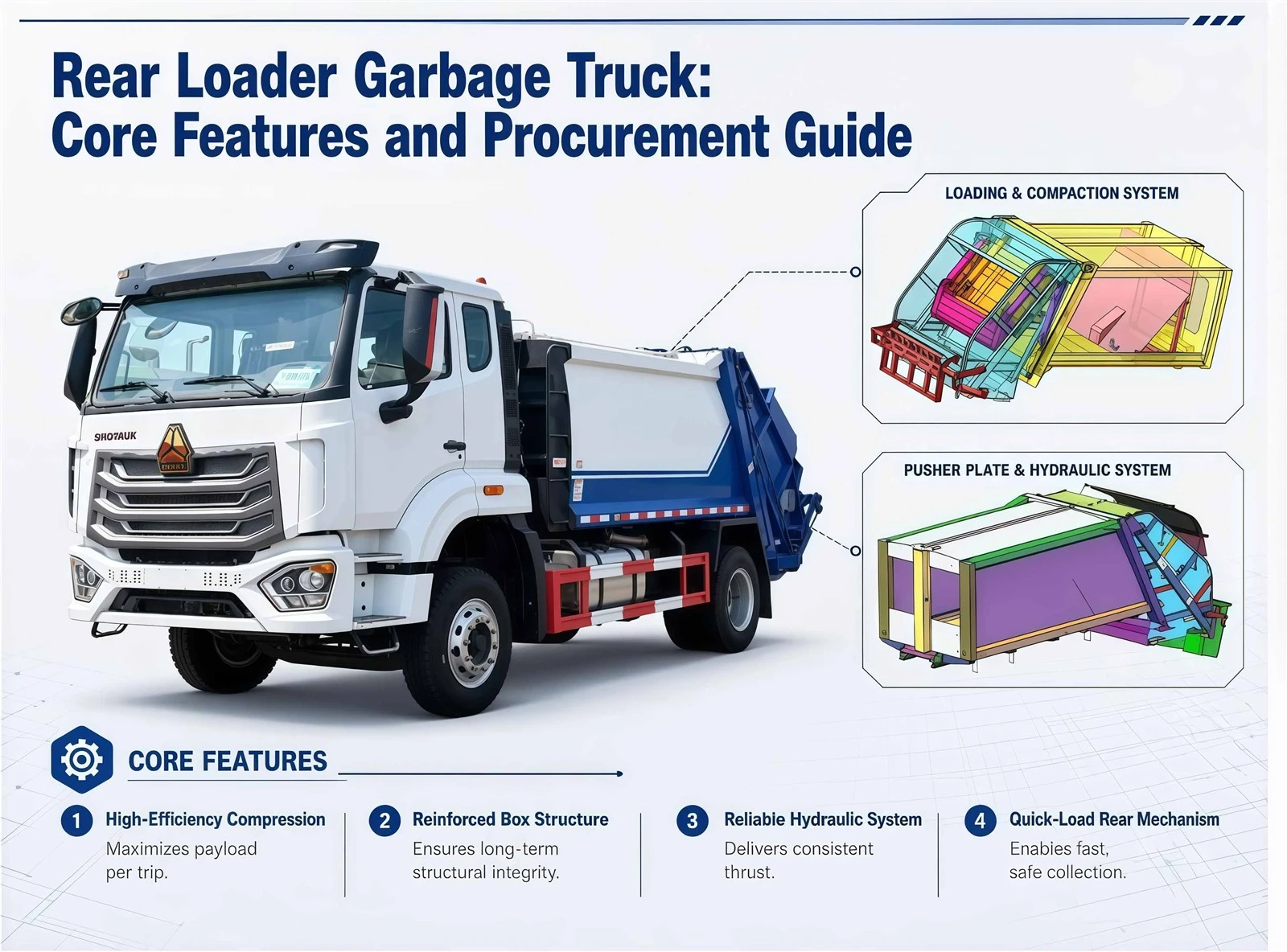
This article concisely summarizes their core features and key selection criteria, providing purchasers and sanitation engineering companies with precise and practical guidance for making informed purchasing decisions.
I.What Is a Rear Loader Garbage Truck?
Rear loader compactor trucks are specialized sanitation vehicles featuring a rear loading design. They incorporate a hydraulic compaction chamber, a sealed waste storage tank, and an automated unloading mechanism into a single integrated system, and are specifically designed for the centralized collection and sealed transport of municipal solid waste and light solid waste.
Unlike side loader and small bucket type garbage trucks, the core structure of this model is concentrated at the rear of the vehicle. It relies on a hydraulically driven compaction mechanism to increase waste loading capacity, making it the mainstay of modern, large scale sanitation collection and transportation.

II.Key Features of Rear Loader Garbage Truck
The rear loader garbage trucks are suitable for most sanitation conditions worldwide, with outstanding core advantages and practicality far exceeding that of ordinary garbage trucks:
✅Compression ratio 1:3–1:6, loading capacity 2–3 times that of ordinary vehicles, significantly reducing costs and increasing efficiency, suitable for large volume waste disposal.
✅Fully sealed tank + sewage tank, leak free and odorless, strictly controlling environmental risks.
✅One button fully automatic operation, single person operation, suitable for overseas labor shortage scenarios.
✅Capacities ranging from 3 to 18CBM cover all needs, making it suitable for use from rural towns to urban areas, and compatible with household waste, dead branches, and lightweight construction debris.
✅Thickened corrosion-resistant tank + universal hydraulic components, strong weather resistance, low failure rate, and convenient maintenance.

III.How Does A Rear Loader Garbage Truck Work?
| Stage | Explanation |
| Loading | The vehicle is equipped with a large capacity filling hopper at the rear, which connects to standard sanitation waste bins via a hydraulic tilting mechanism, automatically lifting and dumping waste into the hopper; manual feeding is also possible. |
| Compression | A multi-stage hydraulic system drives scrapers and pushers in reciprocating motion, continuously compressing loose waste and pushing it into the main tank, significantly reducing its volume. |
| Sealed Storage | The rear of the tank is equipped with a multi-layered sealing structure, ensuring a completely enclosed operation and transportation process. Wastewater is collected in a bottom wastewater tank, preventing leakage and odor spread. |
| Unloading | Upon arrival at the landfill/transfer station, the tank is hydraulically lifted, and pushers simultaneously eject all the compacted waste from the tank, completing the entire operation cycle. |

IV.How to Select the Right Garbage Truck?
During the selection process, the actual operating scenarios and conditions should be taken into account, while also considering environmental compliance requirements and long term operation and maintenance costs. Price or tonnage should not be the sole basis for decision making.
1. Select the Tank Capacity Based on the Application Scenario
| Specifications | Adapted Scenarios | Core Advantages |
| 3-6 CBM | Low volume waste collection scenarios such as towns, residential communities, school campuses, and narrow streets and alleys | Agile handling, low fuel consumption, and great value for the money |
| 8-12 CBM | Daily municipal cleaning of city streets, county town centers, industrial zones, commercial districts, and other areas | Balancing flexibility and cargo capacity, it is suitable for the vast majority of common scenarios |
| 14-18 CBM | Large and medium sized cities, waste transfer station support, high density, high volume waste collection | High capacity and high compression ratio significantly reduce the frequency of transfers |
2.Verify Core Configuration and Process Quality
- Tank Material: Premium thickened manganese steel / stainless steel + wear resistant inner lining to prevent deformation and corrosion; we never use thin walled, low quality tanks.
- Hydraulic System: Utilizes proven, industry standard hydraulic components for stable operation and sufficient compression force, eliminating oil leaks and jamming issues.
- Sealing System: Comes standard with multiple sealing gaskets + an integrated wastewater tank, eliminating drips and odors at the source.

3.Customized to Suit Regional Operating Conditions
| Working Conditions | Core Custom Configuration | Reason |
| High Temperature Dust Storm Regions(Middle East / Africa) | High-temperature resistant hydraulic system, dustproof protection, and enhanced heat dissipation configuration | Avoid shutdowns due to high temperatures and malfunctions caused by sandstorms, ensuring 24/7 operation |
| Coastal High Salt Fog Areas | Full vehicle anti corrosion and rust prevention process, stainless steel tank as standard | Delaying equipment corrosion and aging, significantly extending service life |
| Right Hand Drive Countries(Australia / Southeast Asia / South Africa) | Customized right hand drive vehicles to adapt to local traffic rules | Compliant registration and road use, no additional modifications required |
| Cold Regions | Antifreeze hydraulic system, tank insulation configuration | To prevent pipes from freezing and cracking in winter, and to ensure normal start up and operation in low temperature environments |
4. Match Job Configurations According to Waste Type
| Garbage type | Recommended configuration | Applicable Scenarios |
| Everyday Household Waste | Standard hanging bucket tilting mechanism | Community and municipal routine waste collection: best value for money |
| Mixed Waste, Complex Waste | Enlarged hopper, reinforced scraper, anti-clogging design | Industrial zone and commercial area mixed waste collection |
| Refined Sanitation Project | Intelligent control system, operation monitoring, wastewater filtration device | High-end municipal and industrial park high standard sanitation operations |

V.Common Mistakes to Avoid
1️⃣Say No to Low Quality, Low Cost Models: Low cost models often feature thin walled tanks and generic hydraulic components, making them prone to deformation, oil leaks, and dripping that disturbs residents, resulting in extremely high maintenance costs down the line.
2️⃣Avoid Blindly Choosing High Tonnage Models: Using large trucks on narrow roads or for small waste volumes results in poor maneuverability and high fuel consumption, leading to a waste of resources.
3️⃣Ignoring Localized Customization: Vehicles not adapted to local climate, traffic, and environmental standards are prone to issues such as inability to register, non compliance, and reduced service life.
Avoiding these mistakes can improve operational efficiency and reduce long term costs.

VI.Conclusion
Rear loader garbage trucks are essential for upgrading waste management systems worldwide, thanks to their high efficiency compaction, sealed and eco-friendly design, fully automated operation, and adaptability to diverse working environments. When purchasing such vehicles, it is important to look beyond simple price comparisons. Instead, the appropriate tonnage and configuration should be selected based on specific operational scenarios, types of waste, regional conditions, and regulatory requirements. Priority should be given to models specifically designed for export, which feature robust engineering, strong adaptability, and comprehensive after sales support. This approach ensures long term, cost effective,and highly efficient waste management operations.


