

The water pump is the core power source of a sprinkler truck, directly determining the vehicle's water output efficiency, spray pressure, ease of operation, and long term service life. Currently, the mainstream configurations for sanitation sprinkler trucks worldwide are self-priming pumps and centrifugal pumps. Many municipal procurement agencies, engineering contractors, and equipment dealers easily confuse the differences between these two types, leading to incorrect selection, low operational efficiency, and high subsequent maintenance costs.
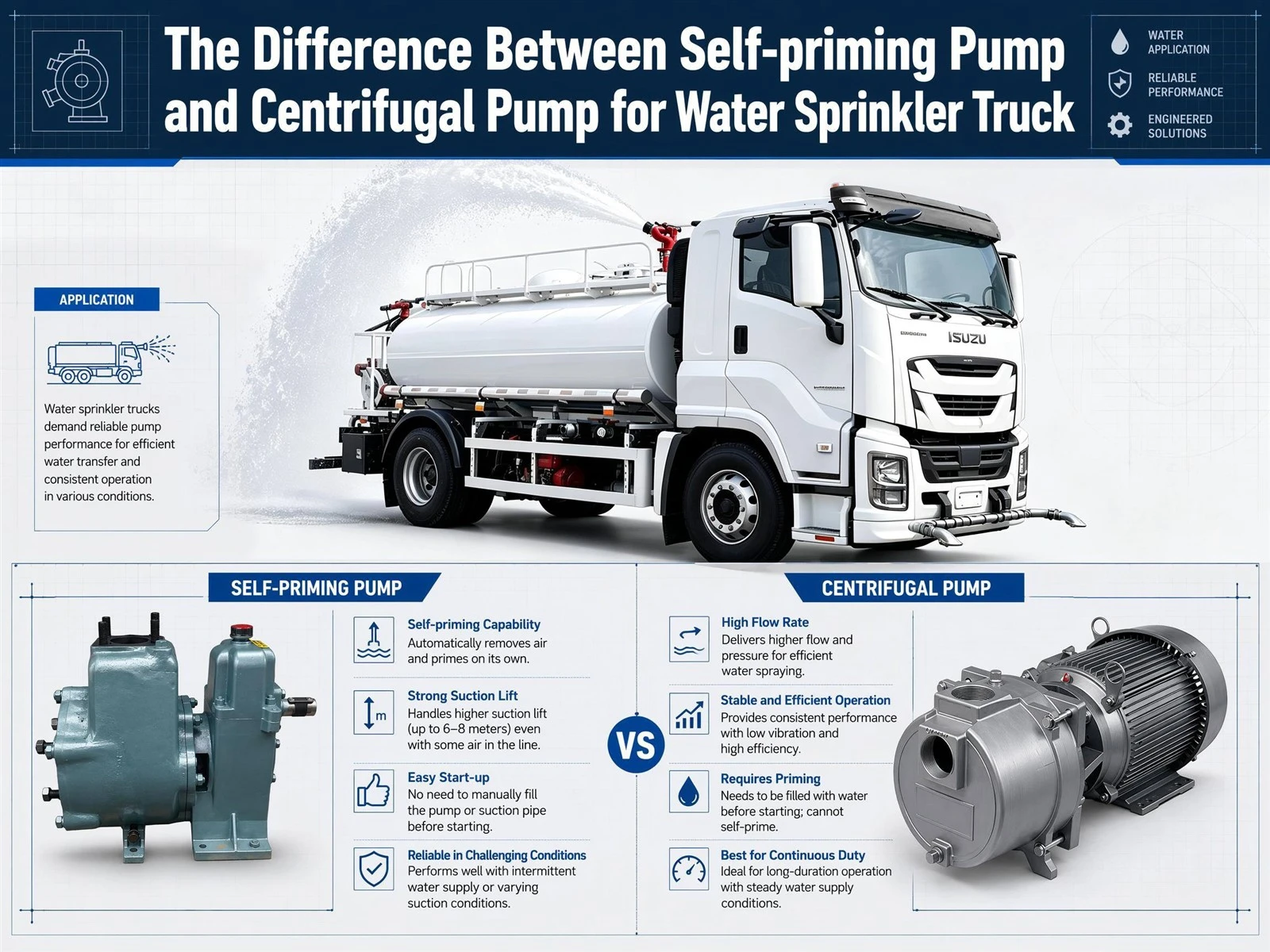
This article provides a comprehensive comparison of the structure, performance, service life, failure rate, and suitable scenarios of dedicated self-priming pumps and centrifugal pumps for sprinkler trucks, helping you make accurate selections and avoid procurement risks.
What Is a Self-priming Pump?
The self-priming pump integrates water storage and gas liquid separation structure, it can automatically draw water under negative pressure after one filling, has strong fault tolerance, and is easy to operate. It is a standard water supply pump for lightweight sprinkler trucks used in municipal greening.
Key Features of Self-priming Pump:
- Water Absorption Structure: Features a built in water storage chamber and gas liquid separation device, automatically absorbing water after a single filling, eliminating the need for priming and venting during each operation.
- Operational Tolerance: Slight air intake or brief water shortages in the pipeline do not affect restarting, adaptable to frequent start stop operations.
- Water Output Performance: Stable low to medium pressure water output with a gentle flow, suitable for road sprinkling and green plant irrigation.
- Operational Ease: Integrated structure, simple operation, suitable for beginners and scenarios lacking professional maintenance personnel.
- Working Condition Adaptability: Primarily designed for intermittent, light load sanitation operations, highly versatile for urban cleaning and park landscaping.

What Is a Centrifugal Pump?
The centrifugal pumps do not have a self-priming water storage structure and require pre-priming. They achieve high pressure, high flow water supply by rotating the impeller; its structure is wear resistant and durable, which are suitable for high intensity continuous washing operations in mining areas and roads.
Key Features of Centrifugal Pump:
- Water Suction Structure: No water storage chamber or self-priming mechanism; the machine must be filled with water and all air purged before startup. Air intake will prevent it from drawing water.
- Water Output Performance: High pressure and high flow rate, strong flushing impact, and excellent long distance continuous water supply capability.
- Structural Durability: Simple and robust construction, wear resistant impeller, no complex negative pressure components, and few vulnerable parts.
- Suitable Operating Conditions: Suitable for long term, uninterrupted, high intensity flushing operations; suitable for heavy dust environments such as mines and construction sites.
- Operational Difficulty: Cumbersome operation process; manual water priming and air purging are required each time the machine is started, making it unsuitable for frequent start stop scenarios.

Self-priming Pump vs. Centrifugal Pump: Key Differences
1.Performance Differences
| Comparison Item | Self-priming Pump | Centrifugal Pump |
| Water Absorption Capacity | Strong self-priming capability, fast water intake, high tolerance for operational errors, and capable of handling conditions with slight air ingress | It has no self-priming capability and requires an extremely tight seal; once air enters, it cannot draw water |
| Water Discharge Pressure | Steady water flow at medium to low pressure, with a gentle and even stream | High pressure and high flow rate, powerful cleaning force, and longer spray range |
| Operating Flow Rate | Medium traffic volume, suitable for intermittent daily operations | Extremely high flow rate, supporting long periods of continuous, high intensity operation |
| Operational Difficulty | Extremely low; requires no professional maintenance; ready to use whenever you need it | Relatively high; requires priming and venting at every startup, which is a cumbersome process |
| Operating Noise Level | Low noise, smooth operation | High rotational speed, relatively loud noise |
2.Service Life and Maintenance Cost Differences
(1) Service Life Differences
Self-priming Pumps: Due to their built in negative pressure water storage structure, the water seal and sealing components are vulnerable parts. Long term idling or dry running can easily cause wear to the cavity. Under the premise of compliant maintenance, the normal service life is 2-4 years, suitable for light load and intermittent operation.
Centrifugal Pumps: Featuring an extremely simple design with no complex or vulnerable components, the impeller and pump housing are thick, wear resistant, and highly durable, with virtually no parts subject to high frequency wear. With regular maintenance, they have a service life of 4–6 years, far exceeding the durability of self-priming pumps.
(2) Maintenance Cost Differences
Self-priming Pumps: It is prone to malfunctions such as water seal leakage, negative pressure attenuation, slow water absorption, air accumulation in the water storage chamber, and water locking failure. The frequency of replacement of vulnerable parts is high, resulting in long term maintenance costs. It is suitable for overseas projects with insufficient maintenance personnel and requiring lightweight operations.

Centrifugal Pumps: It only suffers from basic issues such as air intake idling and minor leaks. Its parts are universal and inexpensive, and global localized repairs are convenient, resulting in anextremely low failure rate and lower long term overall maintenance costs. Suitable for high intensity, routine operations in mining, industrial, and key municipal projects.

3.Application Scenarios Differences
(1) Self-Priming Pumps: Suitable Applications
Featuring convenience, reliability, and ease of use, this is the standard configuration widely adopted by municipalities around the world:
- Routine road watering, surface cooling, and light cleaning in urban and rural areas.
- Irrigation and maintenance of parks, industrial parks, and residential landscaping.
- Intermittent dust suppression operations in small scale sites and communities.
- Unprofessional maintenance personnel, unattended operations, and bulk municipal procurement projects.
- Lightweight sanitation needs in Southeast Asia, Australia, and other regions.

(2) Centrifugal Pumps: Suitable Applications
Centrifugal pumps are characterized by their high pressure and heavy duty capabilities and are suitable for harsh industrial environments:
- High pressure washing of stubborn mud and sand on urban main roads
- Severe dust control in mines, construction sites, coal yards, and slag heaps
- Continuous operation of 15-20m³ large heavy duty water trucks
- High intensity road cleaning operations in dusty areas of the Middle East and Africa
- Engineering projects with strict environmental assessments and high requirements for washing intensity

Choose The Right Pump For Your Sprinkler Truck
| Scene | Recommended Pump | Reason |
| Routine municipal cleaning, landscaping maintenance, and light duty operations | Self-priming Pump | Easy to operate, low failure rate, and suitable for most common operating conditions |
| Mining sites, heavy dust conditions, high pressure washing, and continuous all weather operations | Centrifugal Pump | Adequate pressure, long service life, and better overall value for money |
| Bulk purchasing and mixed scenario operations | Upgraded and Enhanced Self-priming Pump | Combines convenient water suction with standard high pressure performance, making it suitable for sanitation operations in the vast majority of countries worldwide |
Conclusion
In summary, self-priming pumps offer advantages such as ease of operation, stable water intake, and low daily maintenance requirements; while centrifugal pumps offer advantages such as high pressure, large flow rate, long service life, and low long term maintenance costs.
Clearly distinguishing between self-priming and centrifugal pumps helps overseas buyers avoid selecting the wrong product, improves the efficiency of sprinkler trucks, and reduces long term operating and maintenance costs. Customers can choose the most suitable pump configuration based on local working conditions and actual cleaning needs to maximize the service performance of their vehicles.


