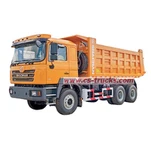
Dump truck is a specialized vehicle with a hydraulic lifting system. It unloads materials by tilting its box, using gravity to empty the load. These trucks are mainly used to transport bulk goods like sand, gravel, ore, coal, and grain. Their core value is mechanizing the unloading process-boosting efficiency while reducing labor costs. For Algerian customers, choosing a dump truck that can handle local terrain and working conditions is critical.

I. Dump Truck Classifications
1. By Application
Dump trucks can be divided into two main types:
- Highway Dump Trucks: Used for short-distance transport in cities and rural areas.
- Off-Highway Heavy Dump Trucks: Designed for mining operations and large-scale construction projects.

2. By Load Capacity
| Grade | Load Range | Typical Applications |
|---|---|---|
| Light-Duty | < 3.5 tons | Farming, sand yards, small construction sites |
| Medium-Duty | 4–8 tons | Municipal projects, building material transport |
| Heavy-Duty | > 8 tons | Mining, large infrastructure |
For large-scale mining in Algeria, we recommend heavy-duty dump trucks with a load capacity of over 30 tons to efficiently transport minerals like iron ore and phosphate.
3. By Transmission Type
- Mechanical Transmission: Main choice for trucks under 30 tons.
- Hydraulic Mechanical Transmission: Common in medium and heavy trucks.
- Electric Transmission: Preferred for mining trucks over 80 tons.
4. By Dumping Method
Various dumping methods exist, with rear tipping being the most widely used (over 90% of applications).
- Side Tipping: Suitable for narrow work sites where changing dumping direction is difficult.
- High-Lift Tipping: Used when materials are piled high and need dumping from an elevated position.
- Bottom Dumping & Three-Way Tipping: Used in specialized applications.
Given Algeria's complex mine terrain, side tipping may work if space is tight. But under normal conditions, rear tipping remains the most efficient and reliable choice.

5. By Lifting Mechanism
Lifting mechanisms fall into two categories: direct push and lever combination types.
- Direct Push: Includes single-cylinder, double-cylinder, and multi-stage designs. Compact and efficient-top choice for light trucks.
- Lever Combination: Includes front-mounted, rear-mounted, and center-mounted levers. Known for smooth operation and less effort-widely used in medium and heavy dump trucks.
For heavy-load operations in Algerian mines, we recommend lever combination lifting mechanisms like the F-type or T-type. They provide smooth lifting and excellent lateral rigidity.
6. By Carriage Structure
Carriages can be classified by tailgate opening method (single-way, three-way, or no tailgate) and by floor cross-section shape (rectangular, boat-bottom, or arc-bottom). Arc-bottom or U-shaped carriages allow smoother material discharge.
For common ore transport in Algerian mines, a U-shaped carriage is recommended-it discharges material more smoothly and resists clogging.
II. How the Hydraulic System Works
The dumping process involves four key stages:
1. Preparation: The power take-off (PTO) engages, activating the hydraulic pump. Oil flows from the pump through the distribution valve and back to the tank (normally open design prevents accidental lifting).
2. Lifting: The directional control valve closes. High-pressure oil enters the cylinder, pushing the piston and raising the carriage.
3. Holding: The PTO disengages, stopping the pump. A check valve locks the oil in the cylinder, holding the carriage at any position.
4. Lowering: The return line opens. Oil from the cylinder's lower chamber returns to the tank, allowing the carriage to lower slowly and smoothly by gravity.
The dumping device consists of three basic components:
- Dumping Mechanism: Carriage, sub-frame, hinge pins, and lifting lever mechanism.
- Hydraulic Drive System: PTO, drive shaft, hydraulic pump, piping system, lift cylinder, and distribution valve.
- Accessory Systems: Safety strut, lift limiter, automatic tailgate opener, carriage guide plate, and sub-frame connections.
Algerian mines face high summer temperatures and frequent sandstorms. Pay special attention to the hydraulic system's sealing and heat dissipation.

III. How to Choose the Right Dump Truck
Now that you understand the classifications and working principles, how do you select the most suitable model? Consider these key factors.
1. Choose the Carriage Based on Cargo Type
- For standard bulk goods like sand, gravel, or grain, a regular rectangular carriage works fine.
- For highly abrasive materials like large ore blocks, you need a heavy-duty mining dump body. We recommend HARDOX wear-resistant steel for excellent impact resistance and long service life.
- For weight-sensitive applications, a HARDOX steel carriage can reduce weight by up to 30% compared to traditional 16Mn steel-increasing payload and cutting fuel costs.
2. Choose the Lifting Mechanism Based on Load Capacity
| Truck Grade | Recommended Lifting Mechanism | Core Advantages |
|---|---|---|
| Light-Duty (< 3.5t) | Direct Push | Compact structure, low cost |
| Medium-Duty (4–8t) | Linkage Combination (F-type/T-type) | Smooth lifting, less effort, safe |
| Heavy-Duty (> 8t) | Linkage Combination (F-type/T-type) | Good lateral rigidity, proven technology |
3. Choose the Chassis Based on Road Conditions
- Highway Dump Trucks: Watch chassis ground height (typically 1050–1200mm for 6×4 chassis) and rear overhang (keep it 500–1100mm). These directly affect stability and lifting safety.
- Off-Highway/Mining Dump Trucks: Choose a dedicated chassis with a short wheelbase and large-diameter, deep-tread tires for good traction on rough terrain.
- Drive Configuration: For high-tonnage transport in Algerian mines, a 6×4 or 6×2 drive configuration is recommended for better load capacity.
4. Choose the Hydraulic System Based on Operational Efficiency
- Lift Cylinder: A multi-stage telescopic cylinder is recommended for its compact design and high pressure capability.
- Control Valve: A normally open type is best-it reduces pump wear and prevents accidental lifting.
- Control Method: Mechanical controls are reliable; pneumatic controls are more responsive. For Algeria's high-temperature, dusty environment, a well-sealed pneumatic control system is the preferred choice.

Selection Summary
To meet the specific demands of Algerian mining terrain and operating conditions, prioritize these factors:
| Consideration | Recommendation |
|---|---|
| Vehicle Type | Off-highway heavy mining dump trucks |
| Load Capacity | Over 30 tons for iron ore, phosphate, etc. |
| Carriage Material | HARDOX wear-resistant steel for impact resistance |
| Lifting Mechanism | F-type or T-type linkage combination for stable lifting under heavy loads |
| Chassis Configuration | Short wheelbase, large deep-tread tires for rough mine roads |
| Hydraulic System | Superior sealing and heat dissipation for high temperatures and dust |
Match these specs to select the most economical and efficient dump truck for demanding Algerian mining operations.