

Back loader garbage trucks, with their advantages of automatic bin attachment, automatic material feeding, large compression capacity, and compatibility with standard garbage bins, are widely sold to markets in Europe, America, Southeast Asia, Africa, and the Middle East. For buyers and maintenance teams, arrival acceptance testing, factory performance testing, and on site operational debugging are crucial steps in avoiding equipment failures and reducing cross border after sales disputes.
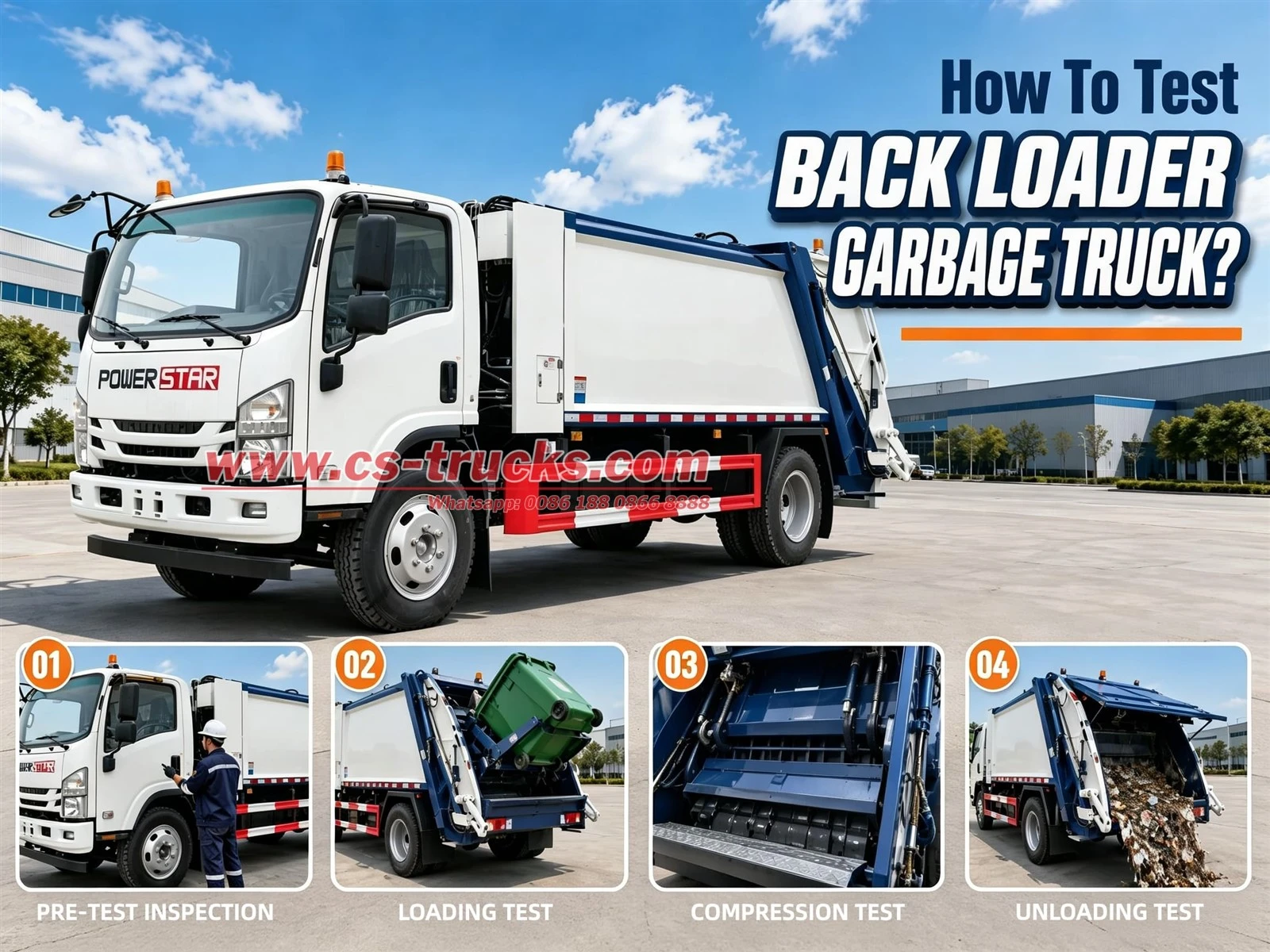
This article provides a standardized and implementable complete testing process for back loader garbage trucks, covering static inspection, empty-load testing, full load operational testing, sealing testing, and safety function verification. It can be directly used as a reference for inspection, arrival acceptance, and presales quality control.
Pre-Test Basic Preparation & Safety Guidelines
Before formal testing, a site pre-inspection should be completed to mitigate testing risks and ensure the effectiveness of the testing.
- Site Positioning: Park the vehicle on a flat, firm surface, engage the handbrake, and install wheel chocks to ensure the vehicle is level.
- Fluid Precheck: Check the levels of hydraulic oil, engine oil, and coolant to ensure they are sufficient and free from cloudiness or contamination.
- Pipeline Inspection: Inspect all vehicle wiring, hydraulic lines, and connectors to ensure there are no loose connections or leaks.
- Safety Clearance: Clear the work area; personnel are strictly prohibited from standing within the rotation range of the loading mechanism and bucket hanging device.
- Material Preparation: Prepare standard plastic trash cans, test materials, and clean water for full load and sealing tests.
📌Testing principles: All overseas site acceptance, factory quality inspection, and customer inspection shall uniformly follow the testing sequence of static first, then dynamic, and no load first, then full load.

Static Structural & Appearance Inspection
Static inspection does not require starting the vehicle; it verifies the overall vehicle manufacturing process and assembly quality, serving as the first line of defense for quality control.
1
The box body, filling hopper, hanging bucket bracket, and push plate compression structure are welded smoothly without any false welds, missing welds, deformation, or twisting; the paint surface is uniform and free of large area scratches or rust.
2
The key points to check are the rubber strips on the rear door of the container, the sealing edge of the filling hopper, and the fit of the sewage tank; the rubber strips should be free of breakage, deformation, and gaps to prevent sewage leakage and odor leakage.
3
Check the hydraulic cylinders, multiway valves, oil pipes, and connectors. The pipelines are neatly arranged without any compression, and all fasteners are properly tightened.
4
The control panel, electronic control buttons, emergency stop switch, warning lights, and reversing lights are all in good working order, and the wiring is properly waterproofed.

No-load Dynamic Function Test (Core Inspection)
Start the vehicle, engage the PTO (Power Take Off), and in an unloaded and garbage free state, continuously cycle through the entire set of operating actions 3–5 times, observing the smoothness of operation.
1. Bucket Lifting Function Test
The bucket support lifts and lowers smoothly without jamming, shaking, or abnormal noise; the tilting and feeding angle meets the standard, and the feeding is clean with no residue; the return and reset are precise and without deviation.
- Compatible with 120L / 240L standard sanitation garbage bins
- Stable connection, no detachment or jamming
2. Loading Hopper Opening And Closing Test
The loading hopper opens and closes smoothly and at a uniform speed, without any impact or abnormal noise. After closing, it fits tightly with no obvious deviation in the gaps.
3. Compression Push Plate Reciprocating Test
- The hydraulic propulsion pressure is stable, and the movement is smooth and uniform.
- The return stroke is smooth without jamming, pressure loss, or slow descent.
- Performance remains consistent across multiple cycles, with no pressure decay.
4. Rear Door Opening, Closing, And Locking Test
The hydraulic rear door opens, closes, and locks normally; the latches engage tightly; the locking pressure is sufficient; and there is no looseness or gap after closing.

Full Load Simulation Working Test
After all the no load tests passed, a simulated full load garbage operation test was conducted to recreate the real sanitation operation scenario and verify the actual operation performance.
1️⃣The container is filled evenly with household waste and dry miscellaneous materials to simulate daily collection and transportation load.
2️⃣The entire operation process, including hanging bucket feeding, compression and pressing, secondary filling, and secondary compression, is continuously completed.
3️⃣The compression thrust is observed to be sufficient, the material is evenly compacted, and there are no instances of insufficient pressure or weak compression.
4️⃣During the full load operation phase, the hydraulic system shows no pressure release, no deceleration, and no abnormal rise in oil temperature.
5️⃣After being fully loaded and allowed to stand for 10–15 minutes, the container, pipelines, and rear door are rechecked for leaks or drips.
This test is crucial in distinguishing between a qualified prototype and a production vehicle that meets the standards, and it is also a mandatory test for on site inspections by major overseas customers.
Sewage Tightness & Anti-leakage Test
Wastewater leakage is the most frequent complaint from customers and requires separate, specialized testing.
- Water Injection Test: Inject clean water into the wastewater tank and filling hopper of the container, and let it stand for 20 minutes.
- Seam Inspection: Inspect the rear door gaps, container welds, pipe connections, and bottom drain outlet; no water leakage or dripping is observed.
- Vibration Test: Perform a tipping and feeding operation to simulate vibration conditions; no wastewater overflow, splashing, or leakage is observed.
- Drain Valve Verification: The drain valve opens and closes smoothly, and completely locks in water when closed, with no seepage.
Vehicles that meet the standards comply with stringent environmental regulations in Europe and the United States, thus avoiding the risk of fines for road pollution.

Safety Protection Function Test
Emergency stop switch test
When the emergency stop button is pressed during operation, all mechanical movements immediately lock down without delay.
Overload protection test
When foreign objects cause obstruction or overload pressure, the hydraulic system automatically releases pressure to prevent engine stalling or damage to the cylinders.
Alert system test
The work warning lights, buzzer, and reversing alarm are triggered normally.
Operational interlock test
If the rear door is not locked or the loading hopper is not reset, the compression core cannot be started, thus avoiding safety accidents caused by misoperation.

Driving & Overall Adaptation Test
After the functional tests are completed, the vehicle's road performance is verified.
- PTO Separation: PTO separation is complete, with no abnormal noises or dragging during vehicle operation.
- Fully Loaded Driving: Under full load and low speed, there is no shaking, abnormal noise, or loose fasteners in the cargo box.
- Road Compliance: Brakes, steering, and all vehicle lights function normally, complying with road regulations.

Common Unqualified Problems in Inspection
| Faults | Influence |
| Insufficient tilting angle of the hanging bucket | High levels of residual waste after disposal lead to decreased collection and transportation efficiency |
| Insufficient pressure on the compression push plate | Full load with false pressure; actual load capacity does not reach the nominal parameters |
| Poor sealing strip fit | Wastewater leakage during the operation caused road pollution and environmental fines |
| Internal leakage in the hydraulic system | Slow movement, static descent and pressure relief, poor reliability of the hydraulic system |
| Safety interlock function malfunction | There are significant operational safety hazards, making it impossible to pass overseas municipal inspections |
| Disorganized piping layout | Vehicles are prone to oil pipe wear and oil leaks after prolonged vibration |
Frequently Asked Questions
Q1: What could be the reason for normal operation under no load conditions, but weak compression under full load?
A: Most of the problems are due to insufficient hydraulic pressure parameter adjustment, clogged hydraulic filter element, or worn hydraulic pump, requiring readjustment of pressure, replacement of filter element, and testing of pump output pressure.
Q2: What should I do if the bucket lifting mechanism shakes and jams?
A: If air gets into the oil circuit, the hydraulic oil is dirty, or the pins lack lubrication, the problem can be repaired by bleeding the oil circuit, changing the hydraulic oil, and lubricating the pins.
Q3: Why do new cars sometimes experience slight water seepage?
A: Generally, this is due to the rubber strip not being pressed firmly or minor deviations in the installation of the rear door. These issues can usually be resolved by fine-tuning the locking mechanism on site, and are not considered defects in the quality of the product itself.
Q4: Do new cars exported require a full set of test reports?
A: Projects in Europe, America, the Middle East, and Australia typically require accompanying factory test records, operational testing videos, and quality inspection reports for project completion and acceptance.
conclusion
The testing and acceptance of rear loader garbage trucks is not simply a matter of starting up and testing; it involves a complete set of standardized verifications of the structure, hydraulics, sealing, safety, and full-load operating conditions.
Standardized factory testing and delivery acceptance can prevent future malfunctions from the outset, reduce overseas maintenance costs, extend equipment lifespan, and is also a direct reflection of the equipment supplier's product strength and professional service capabilities.


