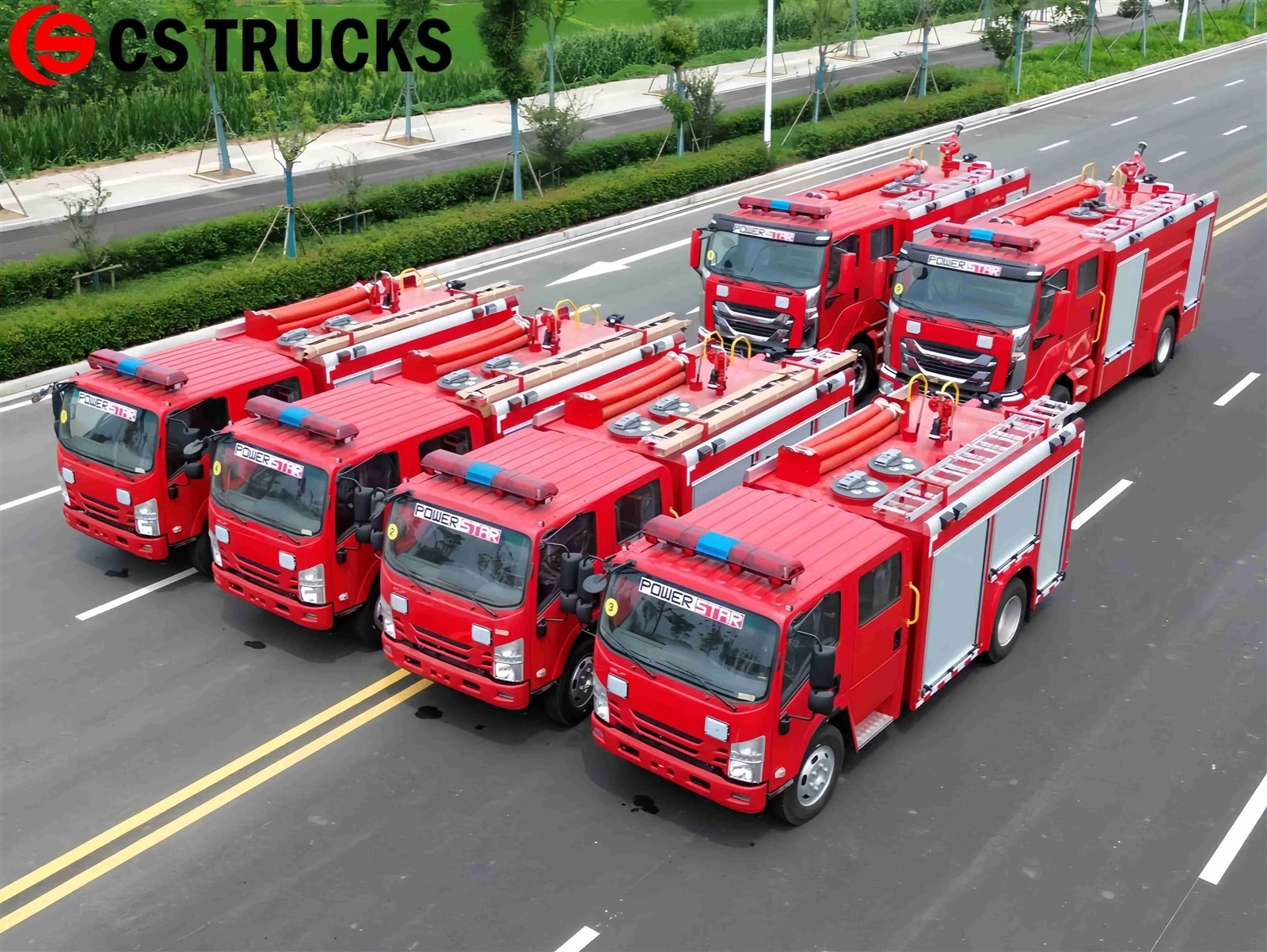
For organizations such as fire departments, industrial facilities, oil depots, and airports, choosing the right foam fire truck is crucial. A primary question for buyers is: what tank capacity should be chosen-3000 liters, 5000 liters, or 8000 liters?
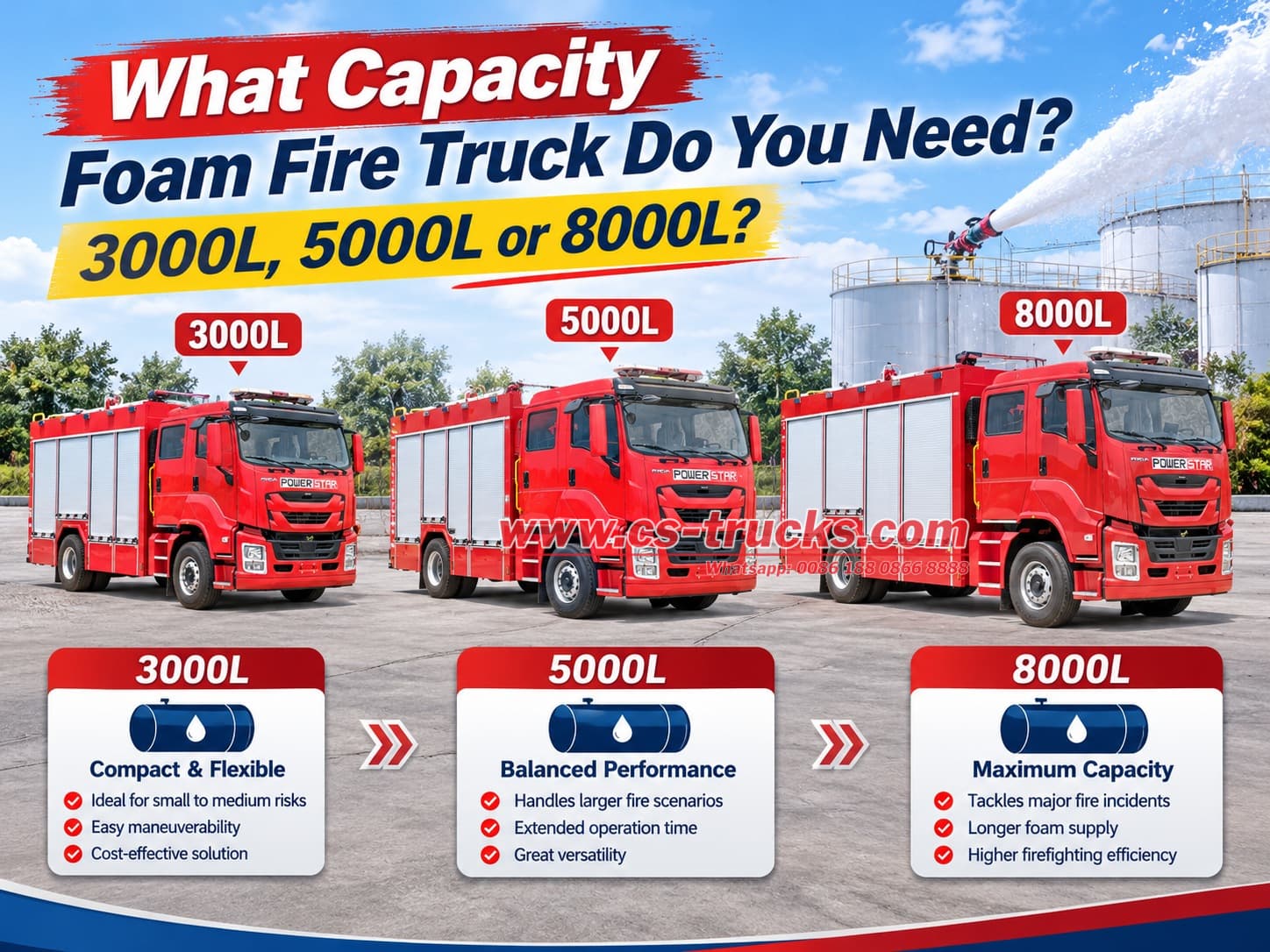
Larger tanks hold more water but require a larger chassis, more operating space, and higher investment; smaller capacity vehicles are easier to maneuver and suitable for locations with limited space. The best choice depends not only on capacity but also on a comprehensive consideration of fire risk, water source conditions, foam system configuration, firefighting equipment, and local operating conditions.
This article will compare 3000 liters, 5000 liters, and 8000 liters foam fire trucks to help you determine the configuration best suited to your needs.
What Does the Capacity of a Foam Fire Truck Mean?
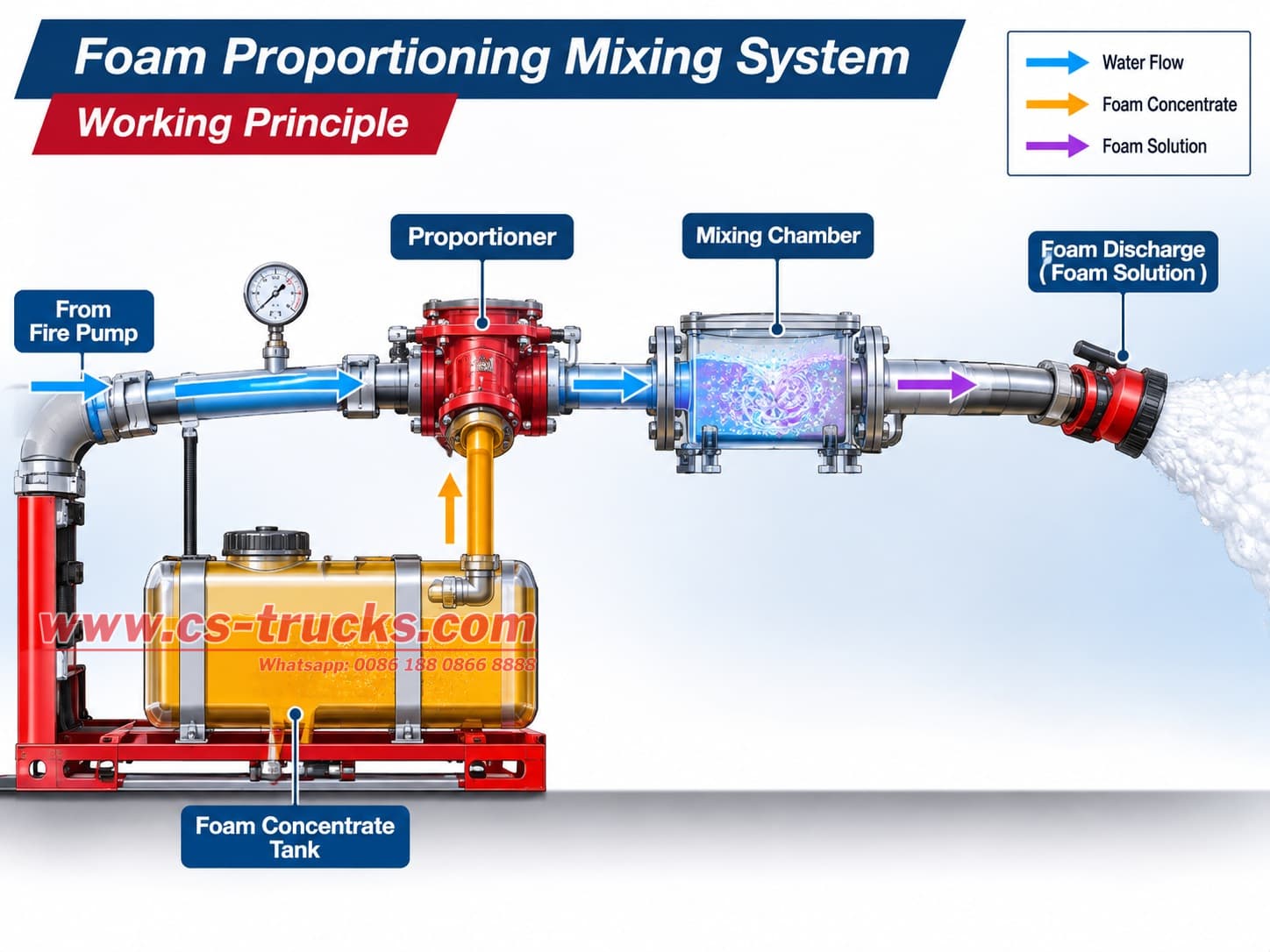
Before comparing foam fire trucks of different capacities, it is necessary to first understand the vehicle's liquid storage system.
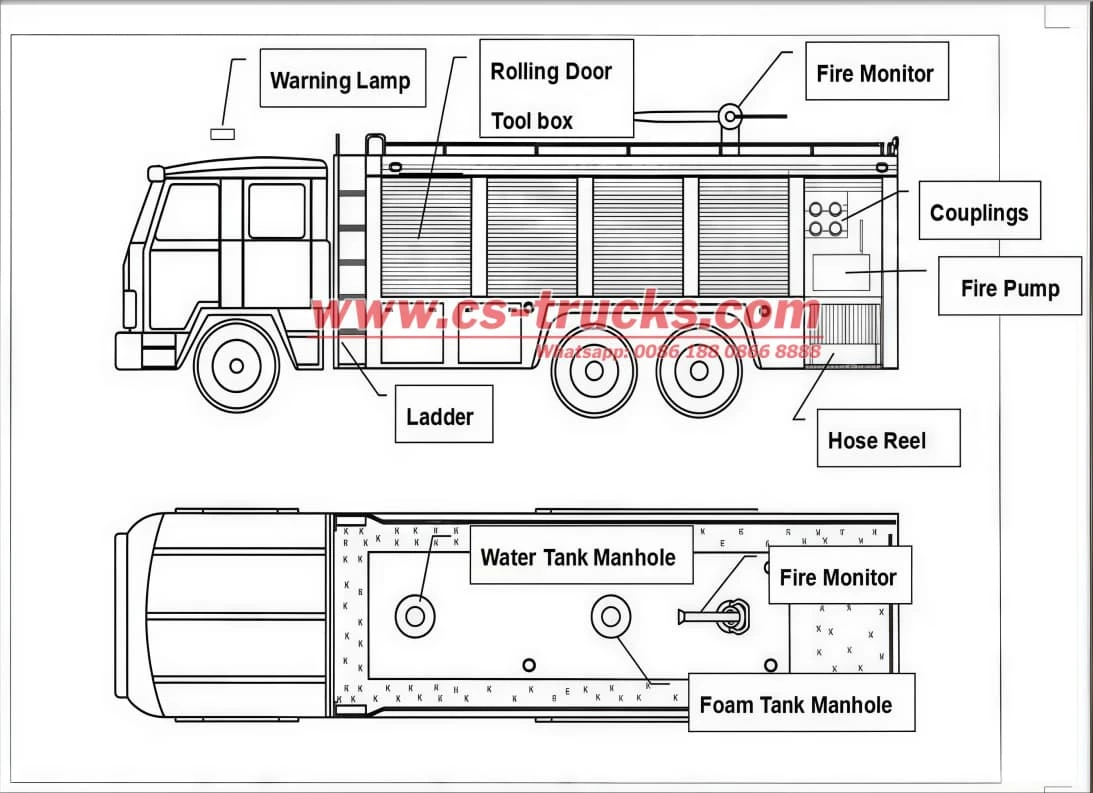
A typical foam fire truck usually includes two separate storage systems:
- Water Tank: Used to store water for firefighting.
- Foam Liquid Tank: Used to store foam extinguishing agent, which is mixed with water through a foam proportioning system to form a foam mixture.
Therefore, when a foam fire truck is referred to as a 3000L, 5000L, or 8000L model, it usually refers to the vehicle's water tank capacity. The foam liquid tank has an independent capacity, which needs to be determined individually based on the specific model and customer requirements.
When making a purchase, it is recommended to focus on confirming the following configurations:
- Water tank capacity
- Foam liquid tank capacity
- Foam proportioning system type
- Fire pump rated flow and pressure
- Fire monitor and water discharge device configuration
- Chassis brand, drive type, and vehicle dimensions
Only by understanding these parameters can we more comprehensively determine whether a foam fire truck meets actual firefighting needs.
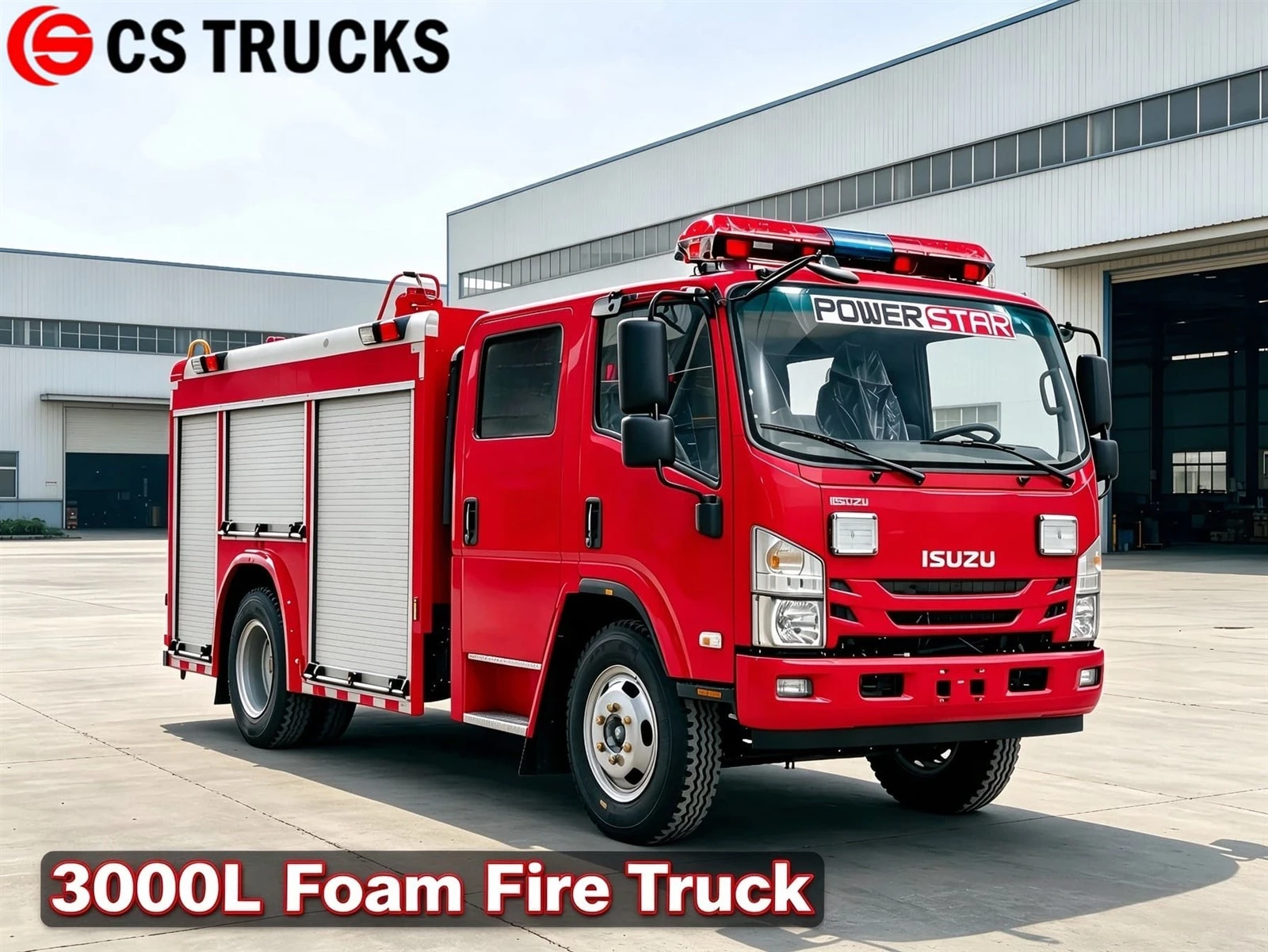
3000L Foam Fire Truck: A Compact Solution for Smaller Operations
The 3000L foam fire truck is a small capacity configuration that can be seriously considered, suitable for some usage scenarios with certain requirements on vehicle size, traffic capacity and procurement cost.
1. Main Advantages
(1) The vehicle has good maneuverability
With appropriate chassis and overall vehicle dimensions, smaller capacity vehicles can better adapt to working environments with narrow roads, limited turning space, or compact sites.
(2) Initial procurement investment may be low
Compared to larger capacity models, the 3000L configuration may have a certain cost advantage in terms of procurement. However, the actual price also depends on the chassis, fire pump, foam system, and other customized configurations.
(3) Suitable for locations with reliable external water supply
If the unit is equipped with fire hydrants, fire pools, or other reliable water sources nearby, vehicles can supplement their water supply through external water supply facilities. In this case, a smaller vehicle mounted water tank may also meet some of the firefighting needs.
2. Typical Application Scenarios
A 3000L foam fire truck can be considered for:
- Small and medium industrial enterprises
- Production workshops and manufacturing plants
- Storage area with external water supply
- Firefighting units with vehicle size requirements
- Places with relatively limited roads and working space
3. What should you pay attention to when purchasing?
A 3000L water tank has a relatively limited water storage capacity. If a large flow of water needs to be continuously discharged at a fire scene, and there is a lack of reliable external water supply, the vehicle may need to be refilled with water more frequently.
Therefore, before selecting the 3000L model, a thorough assessment should be conducted of the site's fire risk, fire water demand, and external water supply conditions.
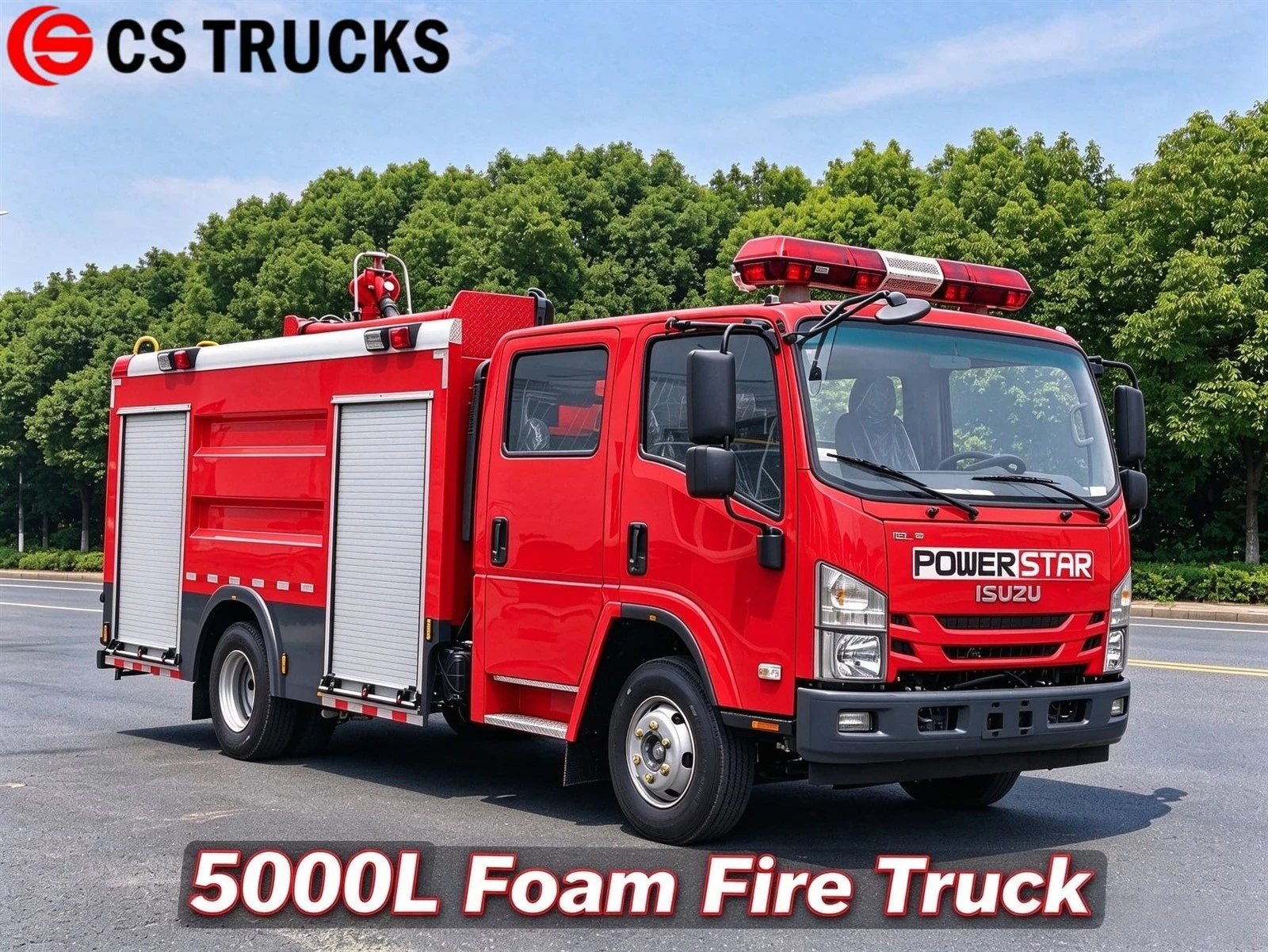
5000L Foam Fire Truck: A Choice Balancing Capacity and Practicality
The 5000L foam fire truck, positioned between small and large capacity models, is a configuration worth considering for many industrial users.
For customers who require a certain onboard water storage capacity while also wanting to consider vehicle size and operational flexibility, the 5000L model offers good value.
1. Main Advantages
(1) Greater onboard water storage capacity
Compared to the 3000L model, the 5000L water tank can store more firefighting water. In situations where external water supply is inconvenient, a larger onboard water capacity may help reduce the frequency of water replenishment.
(2) Wide Range of Application Scenarios
Depending on vehicle configuration and actual firefighting needs, the 5000L foam fire truck can be used in a variety of industrial and commercial firefighting scenarios.
(3) Relatively Balanced Capacity and Vehicle Size
For users who need to store more water than the 3000L model but do not want to directly choose a large fire truck, the 5000L configuration is worth considering.
2. Typical Application Scenarios
The 5000L foam fire truck can be considered for use in:
- Medium sized industrial parks
- Manufacturing and processing enterprises
- Fuel storage and transportation facilities
- Logistics and warehousing centers
- General industrial firefighting sites
- Fire units requiring multifunctional foam fire trucks
3. What should be considered when purchasing?
Increasing the water tank capacity does not necessarily mean a corresponding increase in firefighting capability.
The fire pump flow rate, operating pressure, foam mixing accuracy, fire monitor performance, and water supply system configuration also affect the vehicle's actual firefighting performance.
Therefore, when purchasing a 5000L foam fire truck, a comprehensive evaluation of the entire firefighting system should be conducted based on the specific firefighting scenario.
8000L Foam Fire Truck: Meeting Higher Onboard Water Storage Needs
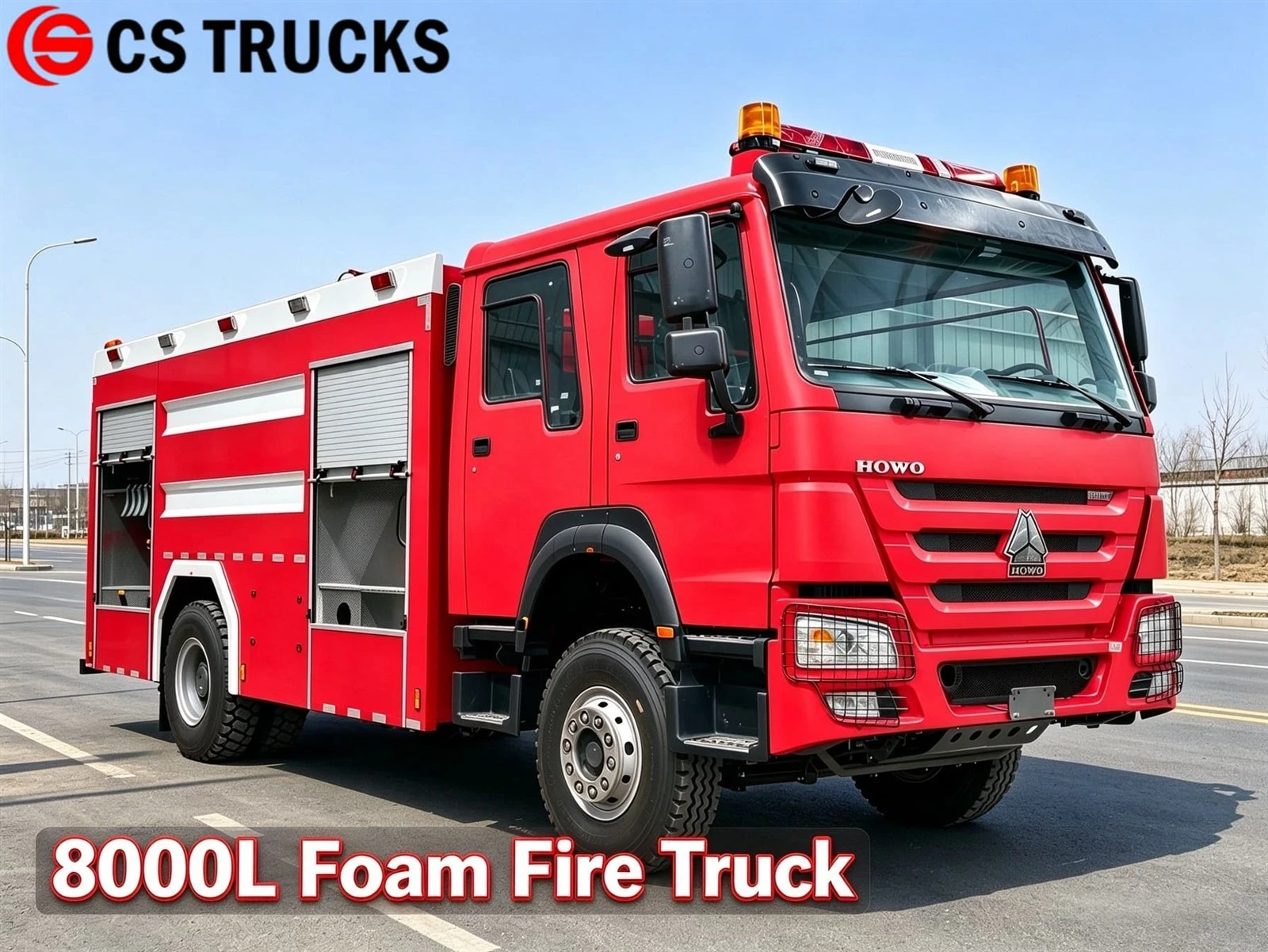
An 8000L foam fire truck represents a large capacity configuration, suitable for users who prioritize onboard water storage capacity when making a purchase decision.
For large industrial enterprises, oil storage and transportation facilities, and locations with limited external water supply, large capacity foam fire trucks can be part of a firefighting force.
1. Main Advantages
(1) Larger Onboard Water Capacity
An 8000L water tank can store more water than 3000L and 5000L models. This larger onboard water capacity is advantageous when the fire scene is far from external water sources or when water replenishment is inconvenient.
(2) Suitable for Large Industrial Sites
Large industrial parks, fuel tank areas, and other high risk locations may have more complex firefighting needs. Large capacity foam fire trucks can undertake corresponding firefighting and water supply tasks according to firefighting design requirements.
(3) Improved Water Transportation Flexibility
If the distance between the fire scene and the water replenishment point is far, the larger onboard water capacity can reduce the frequency of water replenishment to some extent, providing more water reserves for firefighting operations.
2. Typical Application Scenarios
The 8000L foam fire truck can be considered for use in:
- Large industrial parks
- Oil and fuel storage facilities
- Petrochemical enterprises
- Large warehousing and logistics centers
- Locations with relatively limited external fire water sources
- Industrial fire protection units with high requirements for onboard water storage capacity
3. What should be considered when purchasing?
The larger the water tank capacity, the greater the total weight of the vehicle when full. Therefore, an 8000L foam fire truck places higher demands on the chassis load bearing capacity, axle load, braking system, suspension system, and overall vehicle design.
Before purchasing, it should also be confirmed whether the site has sufficient road width, turning space, ground load bearing capacity, and vehicle parking space.
3000L vs. 5000L vs. 8000L: Which One Is Right for You?
| Comparison | 3000L | 5000L | 8000L |
| Water storage capacity | smaller | medium | Larger |
| Vehicle configuration | A relatively compact configuration can be adopted | Medium capacity configuration | Typically requires a larger overall vehicle configuration |
| Mobility | Depending on the chassis and overall vehicle dimensions, it is generally easier to adapt to limited spaces | Depending on the chassis and vehicle size | The road and turning space need to be given special consideration |
| Water replenishment requirements | Frequent water replenishment may be necessary during continuous operation | Relatively centered | The vehicle has a large onboard water storage capacity, which may reduce the frequency of water replenishment |
| Typical applications | Small and medium sized venues | medium sized industrial sites | Large industrial sites and sites with high water storage requirements |
| Initial investment | Possibly lower | Depending on configuration | Possibly high |
| Chassis requirements | Determined based on the overall vehicle design | Determined based on the overall vehicle design | The load and axle load need to be carefully calculated |
⚠️Note: The above is a general comparison and does not represent the actual performance of all vehicle models. Vehicle dimensions, full load weight, fire pump flow rate, range, and continuous operating time must be determined based on the specific technical parameters provided by the manufacturer.
Five Factors to Consider Before Choosing a Foam Fire Truck
Water tank capacity is only one aspect of selecting a foam fire truck. The following five factors should also be considered before purchasing.
1. Fire Risks and Usage Locations
Different types of venues face different fire risks, and therefore have different requirements for fire trucks and foam systems.
For example:
- Manufacturing Plants: May require appropriate firefighting equipment for fires involving common combustibles or flammable liquids.
- Fuel Storage Facilities: Require the selection of suitable foam extinguishing systems based on the fire risk associated with flammable liquids.
- Airports: Must meet applicable airport fire and rescue vehicle and related fire safety standards.
- Chemical Plants: Fire safety plans must be determined based on the types of chemicals stored and used, on site risk assessment, and relevant regulations.
When selecting a foam fire truck, the type of fire at the target location should be determined first, and then the foam extinguishing agent and fire protection system configuration should be determined.
2. External Water Supply Conditions
If a reliable fire hydrant is available nearby, a smaller capacity vehicle mounted water tanker may suffice for some operational needs.
Before selecting a tanker, it is recommended to assess the following:
- Distance to the nearest fire hydrant or water source
- Flow rate and pressure of the external water source
- Reliability of the water supply system
- Time required for water replenishment
- Estimated duration of firefighting operations
If external water supply is readily available, a 3000L or 5000L configuration is recommended; if the water source is far away or the water supply capacity is limited, a larger capacity configuration such as 8000L can be further evaluated.
Ultimately, the selection should be based on the fire protection design and actual operational requirements.
3. Foam Liquid Tank Capacity And Proportioning Mixing System
Besides the water tank capacity, the foam concentrate tank capacity is also crucial.The foam concentrate tank capacity needs to be determined based on the type of foam extinguishing agent, mixing ratio, expected operating flow rate, and continuous operating time.
During procurement, the following should be confirmed:
- Whether the foam proportioning system is suitable for the planned foam concentrate usage
- Which mixing ratios the system supports
- Whether the proportioning system is suitable for the required operating flow rate range
- Whether the foam concentrate is compatible with system materials and equipment
- Whether the system is easy to clean and routinely maintain
It should be noted that not all foam fire trucks are directly compatible with all types of foam extinguishing agents. Specific compatibility should be based on the equipment manufacturer's technical specifications.
4. Chassis and Vehicle Load Bearing Capacity
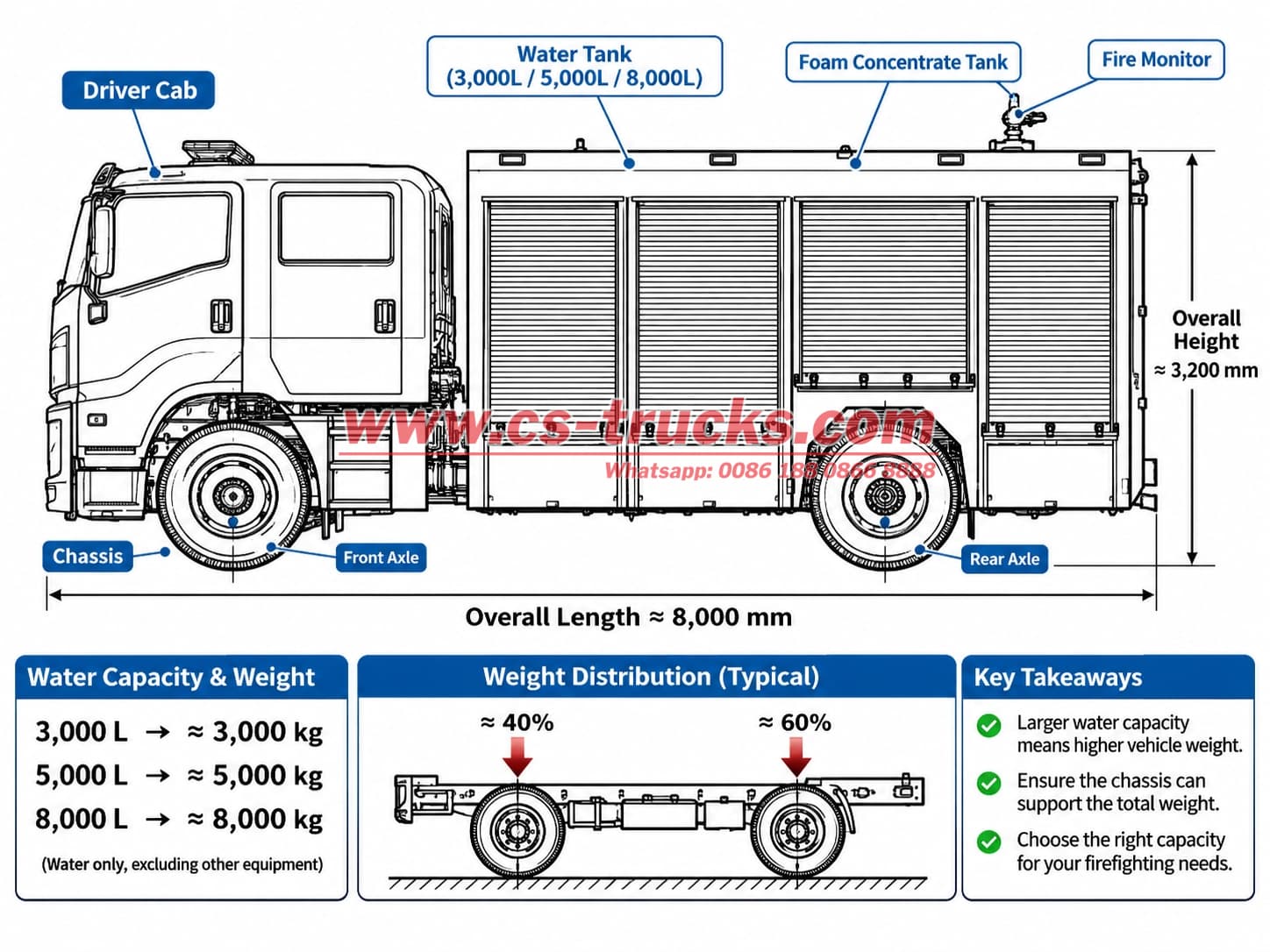
The larger the water tank capacity, the greater the weight after filling with water.Assuming water density is approximately 1 kg/L, the weight of water alone is estimated as follows:
- 3000L: 3000 kg
- 5000L: 5000 kg
- 8000L: 8000 kg
These figures represent the weight of water only and do not include the weight of foam concentrate, chassis, superstructure, fire pump, piping, fire equipment, passengers, and other accessories.Therefore, vehicle design must comply with the maximum permissible gross weight and permissible axle load requirements specified by the chassis manufacturer.
When selecting a large capacity foam fire truck, the manufacturer must conduct a reasonable calculation of the overall vehicle weight and load bearing capacity.
5. Procurement Budget and Long Term Usage Costs
The initial investment for a large capacity foam fire truck may be higher, but procurement cost should not be the sole criterion.It is recommended to also consider the following long term costs:
- Vehicle purchase price
- Fuel consumption
- Routine maintenance costs
- Fire pump and foam system maintenance costs
- Spare parts replacement costs
- Foam extinguishing agent procurement costs
- Operator training costs
- Regular inspection and compliance costs
The most suitable vehicle type is not necessarily the one with the largest capacity, but rather the one that meets firefighting requirements while balancing procurement costs and long term operating costs.
How to Estimate Your Required Water Tank Capacity
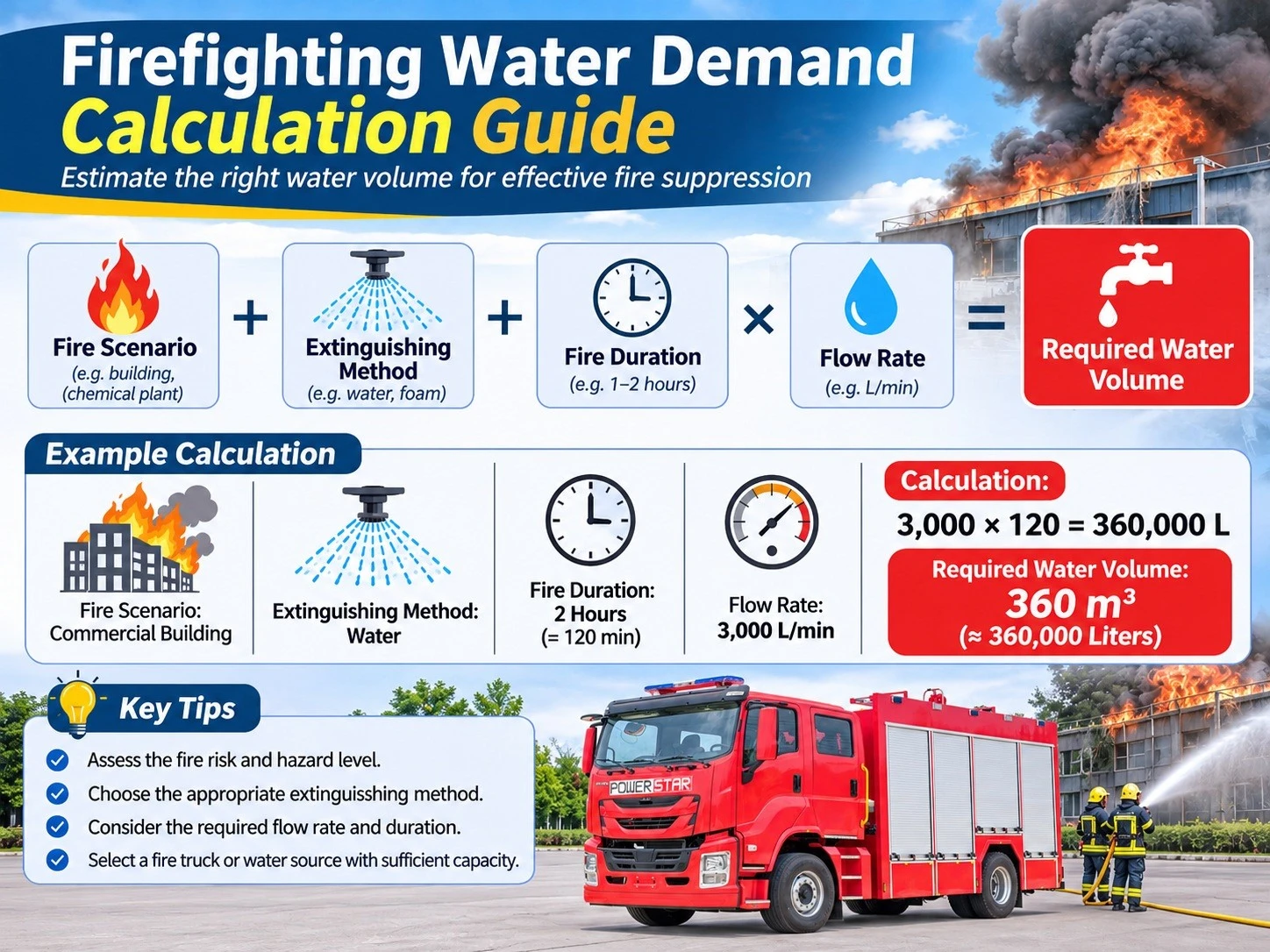
Before selecting a foam fire truck, a preliminary estimate of water demand can be made based on the expected fire operation flow and duration.
A simple calculation formula is:
Required water volume (L) = Water flow rate (L/min) × Operating time (min)
For example:
Assuming a firefighting operation requires a water flow rate of 1000 L/min for 5 minutes, the theoretical water consumption is:
1000 × 5 = 5000L
This means that, under the simple condition of not considering other factors, the theoretical water requirement for this operation is 5000L.It is important to emphasize that this is only an example calculation and does not represent recommended fire pump parameters or a complete fire protection design scheme.
Actual needs also require consideration of foam proportioning systems, water outlet equipment, simultaneous operation of multiple outlets, external water supply conditions, necessary water storage capacity, and applicable fire protection standards.
It is recommended that a professional fire protection technician conduct an assessment based on the site conditions before finalizing the water tank capacity.
Why Custom Configuration Matters
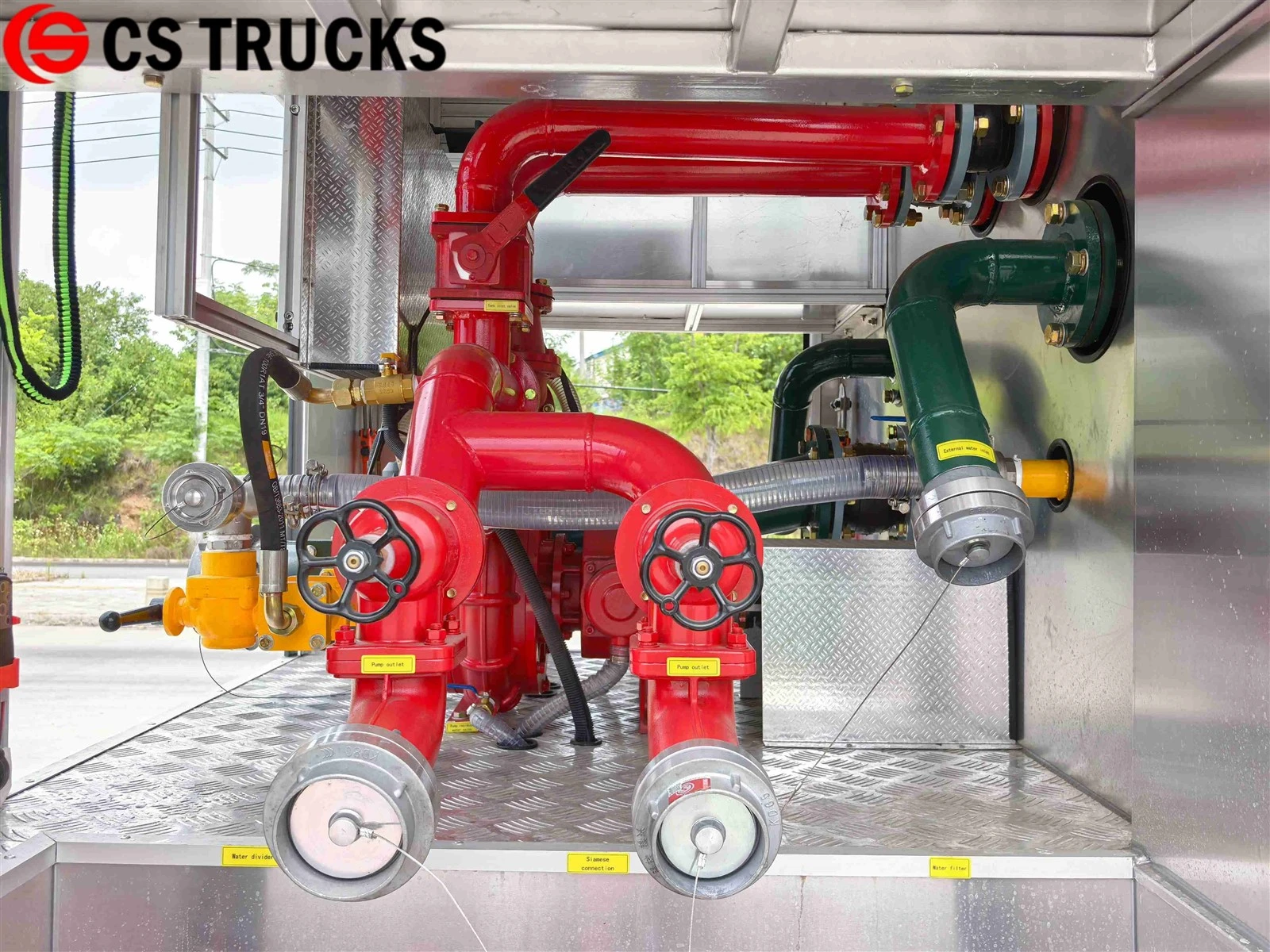
Different industrial sites and fire departments have varying needs for foam fire trucks. Therefore, selecting a foam fire truck that can be configured to meet specific requirements is crucial. Depending on the specific vehicle design and regulatory requirements, manufacturers typically offer the following customization options:
- Water tank capacity
- Foam concentrate tank capacity
- Fire pump specifications
- Foam proportioning system
- Roof mounted or front mounted fire monitor
- Fire hose reel and connectors
- Chassis brand and drive type
- Cabin configuration
- Overall vehicle dimensions and equipment layout
When consulting on custom foam fire trucks, it is recommended to provide the manufacturer with the intended use of the vehicle, local road conditions, required firefighting equipment, and applicable technical standards. This will help the manufacturer recommend a vehicle configuration that better meets actual usage needs.
Frequently Asked Questions
Q1: Is an 8000L foam fire truck always better than a 5000L model?
A: Not necessarily. The 8000L model has a larger onboard water storage capacity, but it usually also requires a larger chassis, vehicle size, and more usable space. If there are reliable external water supply facilities on site, or if vehicle maneuverability is limited, the 5000L model may be more practical.
Q2: What is the difference between a water tank and a foam extinguishing agent tank?
A: Water tanks are used to store firefighting water, while foam extinguishing agent tanks are used to store foam extinguishing agents. They are different storage components in a foam firefighting system and their capacities need to be determined separately.
Q3: How should the capacity of the foam concentrate tank be selected?
A: The capacity of the foam concentrate tank needs to be determined based on the type of foam extinguishing agent, mixing ratio, expected operating flow rate, and continuous operating time. The foam concentrate tank should be designed as a whole with the water tank and proportioning system.
Q4: Does a larger water tank capacity mean a longer firefighting operation time?
A: Not necessarily. The actual operation time also depends on the fire pump flow rate, the water outlet equipment, the number of outlets operating simultaneously, and the external water supply and replenishment conditions.
Q5: Can foam fire trucks be customized to meet customer needs?
A: Many manufacturers can configure or customize water tank capacity, foam liquid tank capacity, chassis, fire pump, foam system, and firefighting equipment according to vehicle design and local regulations. Specific options need to be confirmed with the manufacturer.
Conclusion
3000L, 5000L, and 8000L foam fire trucks each have their applicable scenarios, and there is no single optimal capacity suitable for all users.
- 3000L Foam Fire Truck: Suitable for some small to medium sized locations, applications with limited vehicle space, and applications with good external water supply.
- 5000L Foam Fire Truck: Can be evaluated as a capacity option for many medium sized industrial applications.
- 8000L Foam Fire Truck: Suitable for large locations with higher requirements for onboard water storage capacity or applications where external water sources are not readily available.
Before purchasing, it is recommended to comprehensively assess fire risk, water supply conditions, foam system, chassis load bearing capacity, operating environment, and long term operating costs.
The right foam fire truck isn't necessarily one with the largest water tank capacity, but rather one whose overall configuration truly meets your firefighting needs.
If you are looking for foam fire trucks suitable for industrial parks, oil storage and transportation facilities, or other applications, please provide us with the required water tank capacity, foam liquid tank capacity, chassis requirements, and specific usage scenarios. We can assist you in selecting the appropriate foam fire truck configuration based on your project needs.